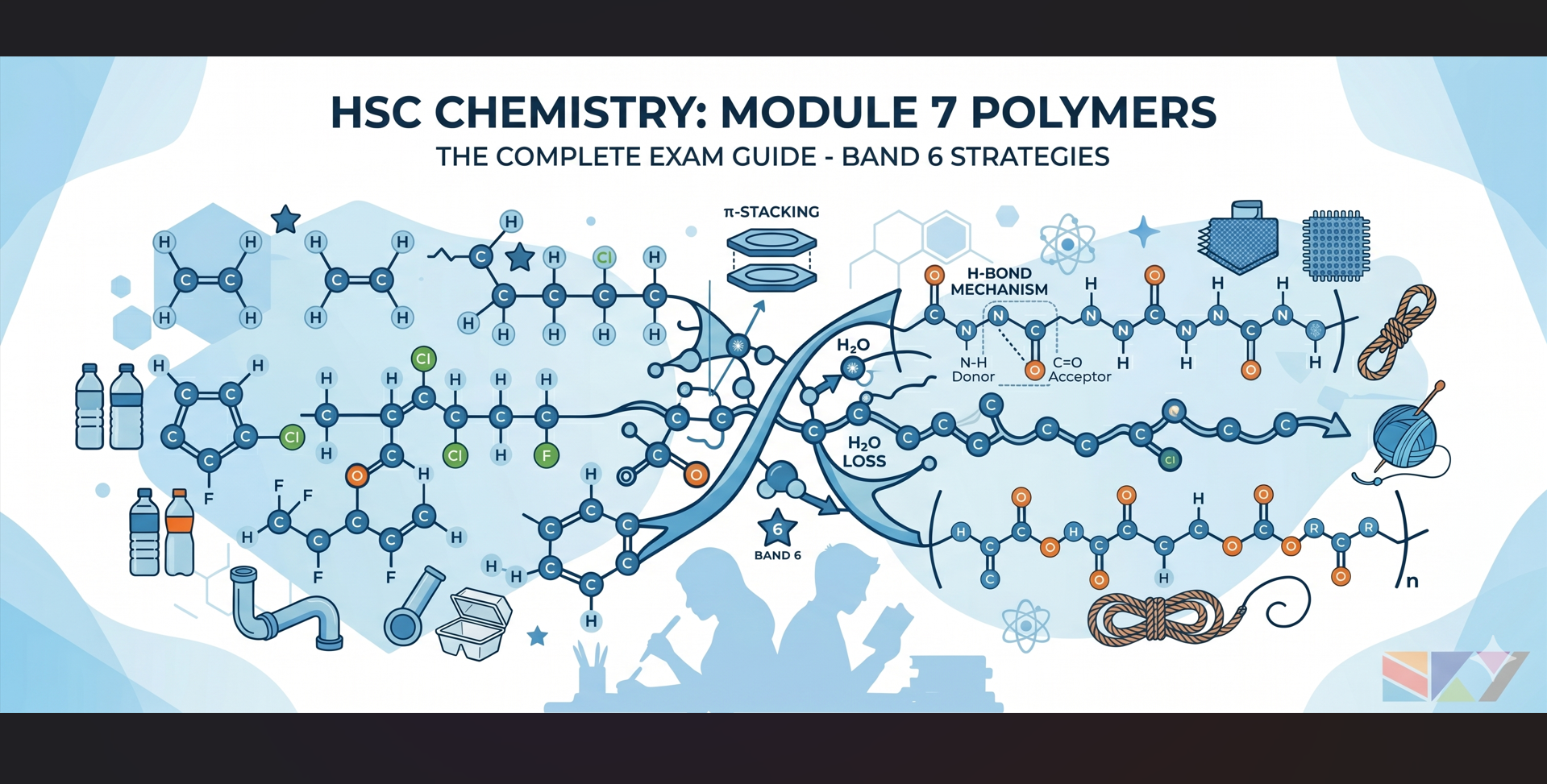
Year 12 HSC Chemistry Module 7 IQ6 — Polymers: The Complete Exam Guide
By the SKY HSC College Chemistry team — 25+ years coaching Sydney HSC students into Band 6.
Last updated: June 2026 · ~50 min revision · ~2 hr first-time read · Targets NESA Stage 6 Chemistry, Module 7 "Polymers" (ACSCH136)
Polymers is the kindest topic in Module 7 — only 2 dot points, only 6 syllabus polymers, only 9 NESA verbs ever used. Yet students still drop marks every year on the MW calculation (2025 HSC Q16), the unseen-polymer IMF analysis (2025 Q28), and the biopolymer monomer ID (2022 Q18, 2024 Q14). Why? Because they memorise polymer names instead of the causal chain markers reward. This guide rebuilds you from the chain up.
⏱️ Pick your study window
| Time you have | Read this |
|---|---|
| ⚡ 5 min | Sections 2 (TL;DR) + 4 (Backbone Diagnostic) |
| ⏱️ 20 min | + Section 3 (Verb Strategy) + Section 7 (MW Calculation) + Section 11 (Master Table) + Section 12 (Cheat Sheet) |
| 📚 2 hr | Everything — every polymer card, every model answer, every Band 6 booster |
💡 Want the interactive version? Every framework in this blog has an interactive companion guide — sortable Master Table, 12-question MCQ quiz with instant feedback, flip flashcards, floating cheat sheet, and dark mode. Use the blog to learn the chemistry; use the interactive guide to drill it.
▶ Open the interactive guide →
(mod7-iq6-polymers.pages.dev — opens the full interactive Module 7 IQ6 guide)
1. Syllabus Decoded — what NESA actually asks
Two dot points. Nine verbs. Six polymers. The whole topic fits on one whiteboard if you know what each phrase demands.
NESA's Stage 6 Chemistry syllabus places IQ6 under the inquiry question "What are the properties and uses of polymers?" and lists exactly two content dot points (both coded ACSCH136):
• "model and compare the structure, properties and uses of addition polymers of ethylene and related monomers, eg: polyethylene (PE), polyvinyl chloride (PVC), polystyrene (PS), polytetrafluoroethylene (PTFE)"
• "model and compare the structure, properties and uses of condensation polymers, eg: nylon, polyesters"
That's the entire prescribed content. Now decode every phrase:
- "model" — visualise the polymer. Markers want the monomer drawn, the C=C double bond opening (addition) or the functional groups condensing (condensation), and the repeating unit in both expanded form (≥3 units) and bracketed form −(…)ₙ−. Two units never count.
- "compare the structure" — the molecular level. Backbone composition (pure C–C vs interrupted by –O– or –N(H)–), side groups (H, Cl, phenyl, F), regularity (crystalline vs amorphous), inter-chain forces (dispersion, dipole–dipole, H-bonds).
- "properties" — the bulk-material level. Density, melting point, rigidity vs flexibility, transparency, chemical inertness. Always link each property to a structural cause.
- "uses" — real-world products. Justify each use with at least one property ("plastic bag because flexible + low cost + inert"). Vague answers like "for packaging" lose marks.
- "addition polymers of ethylene and related monomers" — the four named in the syllabus: polyethylene (PE), poly(vinyl chloride) (PVC), polystyrene (PS), polytetrafluoroethylene (PTFE). Each built from ethene (ethylene) with one or more H replaced.
- "condensation polymers" — the two named: nylon (specifically Nylon-6,6) and polyester (specifically PET). Both require two functional groups per monomer.
🎯 Marker insight from NESA HSC 2019–2025. Out-of-syllabus polymers (Kevlar, PHB, silk) have appeared as unseen-context questions in 2022, 2024, and 2025 HSC. The chemistry is the same; only the monomers are new. If you've mastered the syllabus six, you can answer the unseen ones. We cover both in §8.
The 9 verbs NESA has used on this dot point (2019–2025)
| Verb | NESA glossary definition | Marker keyword to include |
|---|---|---|
| Identify | Recognise and name | Just the name — no explanation needed |
| Outline | Sketch in general terms | One-sentence summary per polymer |
| Describe | Provide characteristics and features | 2–3 properties + 1 use per polymer |
| Compare | Show how things are similar and different | Both "similarly…" and "however…" |
| Contrast | Show how things are different | At least 3 explicit differences |
| Explain | Relate cause and effect | Property → because → structure |
| Calculate | Determine from given facts | Show formula, substitute, evaluate, unit |
| Justify | Support an argument with evidence | "…because…" + named structural reason |
| Predict | Suggest what may happen | "Likely to…" + structural reason |
2. TL;DR — the 6 things every student must know
Internalise these six. Everything else is detail.
-
Addition polymerisation — a chain of unsaturated monomers (containing C=C) link when the π-bond opens and a new C–C single bond forms with the neighbour. No atoms are lost. The 4 syllabus polymers — PE, PVC, PS, PTFE — all start from an ethene-family monomer.
-
Condensation polymerisation — two bifunctional monomers link by reacting their functional groups, eliminating a small molecule (almost always H₂O) at each link. The 2 syllabus polymers are Nylon-6,6 (diacid + diamine → amide link) and PET (diacid + diol → ester link).
-
The marker's causal chain. Every "compare" or "explain why used for" question rewards this structure: use → properties (2–3) → structure (crystallinity, branching, side groups, polar bonds). Don't list properties without the structural reason.
-
MW Calculation is the most-tested core skill. Addition polymer: MW = n × MW(monomer). Condensation polymer (1-monomer self-condensation): MW = n × MW(monomer) − (n−1) × 18.016. Condensation polymer (2-monomer): MW = n × [MW(A) + MW(B)] − (2n−1) × 18.016. Tested directly in 2025 HSC Q16.
-
The drawing rule. When NESA says "draw the polymer", show at least 3 monomer units explicitly AND the abbreviated bracketed form −(…)ₙ−. Two units does not count.
-
The Backbone Diagnostic. Given any polymer structure (named or unseen), look only at the backbone. Pure C–C → addition. Contains –C(=O)–O– → polyester. Contains –C(=O)–N(H)– → polyamide. This 5-second test answers half the marks on any polymer paper.
3. Verb Strategy — what each NESA verb wants
The fastest mark-loss is misreading the verb. "Describe" earns marks for facts; "Explain" demands the cause underneath.
The verb → sentence-opener mapping
| Verb | Marker wants | Opener you should use |
|---|---|---|
| Identify | The name | "[Polymer] is…" |
| Outline | Brief features | "The monomer is X. The repeating unit is Y." |
| Describe | Features with detail | "[Polymer] is X (property), Y (property), and used in Z." |
| Compare | Similarities + differences | "Both X and Y are… However, X has… whereas Y has…" |
| Contrast | Differences only | "Whereas X has…, Y has…" |
| Explain | Cause and effect | "[Property] occurs because [structural feature]." |
| Calculate | Show working | "MW = n × MW(monomer) = …, therefore = …" |
| Justify | Defend the position | "This is appropriate because…" |
| Predict | Forecast outcome | "X is likely to [outcome] because [structural reason]." |
Sentence scaffolds you can copy-paste
📝 Compare scaffold (4-mark question). "Both [Polymer A] and [Polymer B] are [addition/condensation] polymers. They share [common structural feature], so both exhibit [shared property]. However, [Polymer A] has [distinct structural feature], which gives it [distinct property], whereas [Polymer B] has [different structural feature], leading to [different property]."
📝 Explain-property scaffold (3-mark question). "[Property] arises because [polymer] has [structural feature X], which produces [intermediate mechanism], leading to [observable property]."
📝 Justify-use scaffold (4-mark question). "[Polymer] is used for [product] because it is [property 1] and [property 2]. The [property 1] comes from [structural reason]; the [property 2] comes from [structural reason]."
✅ Marker reward. High-scoring answers we've reviewed across NESA HSC 2019–2025 name the structural feature explicitly (e.g. "the polar C=O ester groups give rise to dipole–dipole forces…") instead of just naming the property. The structural noun is the marker keyword.
4. The Backbone Diagnostic — a 5-second test for every polymer Q
Whether you've seen the polymer before or not, the backbone tells you everything.
| Polymer backbone | Diagnosis |
|---|---|
| Pure C–C single bonds only (substituents = H, Cl, F, phenyl, etc.) | ADDITION polymer (PE, PVC, PS, PTFE) |
| –C(=O)–O– at intervals | POLYESTER (condensation; PET) |
| –C(=O)–N(H)– at intervals | POLYAMIDE (condensation; Nylon-6,6, Kevlar, silk) |
Why this works. Addition polymerisation can only break C=C π-bonds, so the backbone is forced to be C–C single bonds. Condensation forms a new bond between two functional groups, so the backbone carries the linkage as evidence at every monomer interface.
Worked use — two recent HSC questions
- 2025 HSC Q28 — Kevlar. The question showed the Kevlar repeating unit. Backbone scan: aromatic rings linked by –C(=O)–N(H)– at every gap → amide → condensation polyamide.
- 2024 HSC Q22 — vinyl fluoride. The question gave the monomer CH₂=CHF and asked for the polymer. C=C in monomer → polymer backbone is pure C–C with F side groups → addition polymer. Drawing form: −(CH₂−CHF)ₙ− with at least 3 units shown.
💡 Exam habit. Before answering any polymer question, write the diagnosis word in the margin: "addition" or "polyester" or "polyamide". This forces you to scan the backbone and prevents calling a polyamide an addition polymer because the question shows C=O somewhere.
⚠️ Trap. PET contains C=C bonds inside the benzene rings, but those are aromatic, not reactive alkene C=C. The backbone still has –C(=O)–O– ester linkages → PET is condensation.
5. Part 1 — Addition Polymerisation
Four polymers, one mechanism, one framework.
5.1 The mechanism — π-bond opens, no atoms lost
Addition polymerisation requires: an unsaturated monomer (containing C=C), a catalyst or initiator, and high temperature/pressure.
① π-bond in C=C breaks (catalyst supplies the trigger)
        ↓
② Each carbon has an unpaired electron
        ↓
③ New C–C single bonds form between adjacent monomers
        ↓
④ Chain extends — thousands of repeating units
General equation: n CH₂=CH₂ → −(CH₂−CH₂)ₙ−
🔑 Atom economy = 100%. Addition polymerisation loses zero atoms. Condensation is the opposite (loses H₂O per link). Your fastest "addition vs condensation" identifier on a calculation question.
⚠️ Catalyst naming. You do not need to name catalysts (Ziegler-Natta, Phillips, peroxide). NESA HSC 2019–2025 has never required specific catalyst names. Just say "under catalysed conditions at high temperature and pressure".
5.2 The Comparison Checklist — 4 structural factors
Every "explain", "compare", or "why used for" question on an addition polymer can be answered using these 4 structural factors.
| # | Factor | What it does |
|---|---|---|
| 1 | Crystallinity | How regular the chain packing is. Crystalline → opaque, high density, rigid, sharp m.p. Amorphous → transparent, lower density, flexible. |
| 2 | Degree of branching | Linear chains pack tightly → crystalline → high density. Branched chains can't pack → amorphous → low density. This is the LDPE vs HDPE difference. |
| 3 | Chain length | Longer chains → more atoms → stronger dispersion forces → higher melting point. Why polyethylene is solid at room temperature but ethene is a gas. |
| 4 | Side groups | Presence (polar groups like C–Cl add dipole–dipole forces) and size (bulky groups like phenyl prevent close packing). Size of side group ∝ stiffness. |
🎯 Marker phrase to internalise. "Structure → packing → IMF type → property." This is the chain every NESA polymer answer should follow.
5.3 Applying the Checklist — LDPE worked walkthrough
📌 Worked example — LDPE (Low-Density Polyethylene).
Step 1 · Branching (Factor 2). LDPE has high branching — many side branches along the chain.
Step 2 · Crystallinity (Factor 1) — caused by Step 1. Branched chains cannot pack closely. Result: amorphous (low crystallinity).
Step 3 · Property output — caused by Step 2. Amorphous packing produces: low density (~0.92 g/cm³) + flexible + translucent.
Step 4 · Side groups (Factor 4). LDPE has no side groups → pure non-polar C–C/C–H backbone → only weak dispersion (London) forces → chemically inert.
Use. Plastic shopping bags, cling film, squeeze bottles — needs flexibility + low cost + chemical inertness.
5.4 The 4 syllabus addition polymers — per-polymer cards
Polyethylene (PE) — split into LDPE and HDPE
🔑 Key contrast. LDPE and HDPE are made from the same monomer (ethene) and have the same chemical formula. The difference is chain geometry: LDPE is branched (amorphous, flexible), HDPE is linear (crystalline, rigid).
| Property | LDPE | HDPE |
|---|---|---|
| Branching | High | Low (linear) |
| Crystallinity | Amorphous | Crystalline |
| Density | ~0.92 g/cm³ | ~0.95 g/cm³ |
| Melting point | ~110 °C | ~135 °C |
| Appearance | Translucent | Opaque |
| Use | Plastic bags, cling film | Milk jugs, water pipes |
📝 Sentence scaffold — LDPE vs HDPE. "LDPE has highly branched chains that cannot pack closely, producing an amorphous structure with low density and flexibility — ideal for plastic bags. HDPE has linear chains that pack tightly in parallel, producing a crystalline structure with high density and rigidity — ideal for milk jugs that must hold their shape under liquid weight."
Poly(vinyl chloride) — PVC
- Monomer: chloroethene (vinyl chloride), CH₂=CHCl
- Repeating unit: −(CH₂−CHCl)ₙ−
- Defining feature: polar C–Cl side group on every second carbon
- IMF result: dipole–dipole forces between chains (stronger than PE's dispersion-only)
- Properties: rigid · higher m.p. than PE · chemically inert
- Uses: rigid PVC pipes · plasticised PVC for electrical wire insulation, vinyl flooring
⚠️ Trap — don't say "PVC has H-bonds". Cl is electronegative but has no H attached to it. PVC has dipole–dipole forces only.
Polystyrene (PS)
- Monomer: ethenylbenzene (styrene), CH₂=CH(C₆H₅). Also acceptable: phenylethene, vinylbenzene.
- Repeating unit: −(CH₂−CH(C₆H₅))ₙ−
- Defining feature: bulky phenyl side group on every second carbon — the largest of the 4 syllabus polymers
- IMF result: dispersion forces only (phenyl is non-polar; there are no polar bonds and no N–H/O–H). The bulky phenyl groups force an irregular (atactic, amorphous) arrangement, so the chains cannot pack closely → glassy, brittle, transparent.
- Uses: Type 1 commercial PS (CD cases, plastic cutlery) · Type 2 expanded polystyrene/Styrofoam (gas-blown to ~95% air — lightweight + thermal insulator)
⚠️ Naming error. "Phenylbenzene" is not a synonym for styrene's monomer. Phenylbenzene = biphenyl, a different molecule. Use ethenylbenzene (preferred IUPAC) or phenylethene or vinylbenzene.
⭐ Beyond syllabus (don't need it for marks). Some textbooks add π–π stacking between benzene rings. NESA's own marking guideline for 2025 HSC Q28(b) describes polystyrene as having "only dispersion forces" — so for full marks, treat PS as dispersion-only. The phenyl ring's job in an exam answer is to prevent close packing (→ brittle), not to add a new force.
Polytetrafluoroethylene (PTFE / Teflon)
- Monomer: tetrafluoroethene, CF₂=CF₂
- Repeating unit: −(CF₂−CF₂)ₙ−
- Defining feature: all 4 H of ethene replaced by F. Symmetric substitution.
- IMF result: Individual C–F bonds are polar, but symmetric placement cancels the net dipole → no dipole–dipole between chains. Only (enhanced) dispersion.
- Properties: extremely chemically inert (C–F is the strongest single bond to carbon) · very low friction · very high m.p.
- Uses: non-stick cookware · plumber's tape · bearings · electrical insulation
⚠️ Trap — PTFE does NOT have strong dipole–dipole forces. Symmetric substitution cancels the net dipole.
5.5 Distinguishing tests — the 1-mark gateway questions
🔑 Bromine water test (the standard answer). The monomer contains a C=C double bond → undergoes addition with Br₂ → decolourises brown bromine water. The polymer has only C–C single bonds → no reaction.
📌 The 1-mark gas-vs-solid gateway. "Polyethylene is a solid at room temperature while ethene is a gas. Explain." (1 mark)
Model answer. "Polyethylene chains are ~10³–10⁵ times longer than ethene. Dispersion (London) forces scale with molecular size, so polyethylene has much stronger total inter-chain attractions than ethene — solid at room temperature, while the small ethene molecule has weak dispersion forces and is a gas."
You have to mention dispersion forces + size scaling explicitly. Saying just "polyethylene is bigger" loses the mark.
🪞 Self-check (60 seconds). Cover the list and explain: Why is HDPE more rigid than LDPE even though both have the same chemical formula? Your answer must mention: linear chains → tight parallel packing → high crystallinity → higher inter-chain attractions per volume → rigidity.
6. Part 2 — Condensation Polymerisation
Two bifunctional monomers. One small molecule lost per link. Water is the giveaway.
6.1 The Master Pattern — every condensation polymer Q follows this
| Monomer 1 (diacid) | Monomer 2 | Linkage formed (in backbone) |
|---|---|---|
| HOOC—R—COOH | + HO—R'—OH (diol) | Ester –C(=O)–O– + H₂O eliminated |
| HOOC—R—COOH | + H₂N—R'—NH₂ (diamine) | Amide –C(=O)–N(H)– + H₂O eliminated |
For n monomers of each type, you get 2n − 1 links → (2n − 1) H₂O molecules eliminated. This is the basis of every condensation MW calculation in §7.
🔑 The Functional-Group Rule. Each monomer must have ≥2 functional groups. If a monomer has only one functional group, the reaction stops at the dimer stage (e.g. methanol + butanoic acid → methyl butanoate, an ester not a polyester).
6.2 Cut-Across-the-Link — find the monomer from the polymer
① Locate the linkage in the chain:
   ester = –C(=O)–O–   amide = –C(=O)–N(H)–
        ↓
② Cut across the link, between C=O and the O or N atom
        ↓
③ Add H to the side with N or O (restoring –OH or –NH₂)
   Add OH to the side with C=O (restoring –COOH)
📌 Worked example — silk (2024 HSC Q14 style).
Polymer section:
… –NH–CH(CH₃)–CO–NH–CH₂–CO–NH–CH(CH₃)–CO– …Cut across each –C(=O)–N(H)– amide link. Add H + OH. Recovered monomers:
- Glycine: H₂N–CH₂–COOH
- Alanine: H₂N–CH(CH₃)–COOH
Silk = a polypeptide built from glycine + alanine repeats.
6.3 PET — Polyester deep dive
| Monomer | Systematic name | Structure | Role in chain |
|---|---|---|---|
| Terephthalic acid | benzene-1,4-dicarboxylic acid | HOOC–C₆H₄–COOH | Contributes the aromatic ring + two C=O carbonyls |
| Ethylene glycol | ethane-1,2-diol | HO–CH₂–CH₂–OH | Contributes the short flexible –O–CH₂–CH₂–O– spacer |
The polymerisation equation:
n HOOC–C₆H₄–COOH + n HO–CH₂–CH₂–OH
        ↓
−[ O–C(=O)–C₆H₄–C(=O)–O–CH₂–CH₂ ]ₙ− + (2n − 1) H₂O
Structure → property chain markers reward.
| Structural feature | IMF / packing consequence | Bulk property |
|---|---|---|
| Polar C=O ester groups | Dipole–dipole forces between chains | High m.p. (~260 °C), rigid |
| No N–H donor | No hydrogen bonds | PET is rigid but less elastic than Nylon |
| Aromatic benzene rings | Rigid planar units + extra dispersion (electron-rich rings) | Extra rigidity + tensile strength |
| Rigid rod-like backbone | Chains align easily | Crystalline when slow-cooled, amorphous (transparent) when rapidly cooled |
| Polar groups buried; C–H surface | Hydrophobic surface | Stain-resistant, food-safe |
Uses linked to properties.
- 🥤 Drink bottles — transparent (amorphous when rapidly cooled), tough, lightweight, food-safe.
- 👕 Polyester clothing fibres — high strength + crystallinity + low water absorption.
- 📼 Magnetic tape, X-ray film, packaging films — flexible when thin, strong, transparent.
🎯 2020 HSC Q12 (MCQ — answer C). The question showed aromatic rings linked by ester groups and asked why the plastic only softens at ~250 °C. The accepted explanation: PET chains are held by dipole–dipole forces (from the polar C=O ester groups) plus dispersion forces; these IMFs must be overcome to soften the plastic. PET has no N–H or O–H, so it cannot hydrogen-bond — which is why "H-bonding" is the wrong option. (Naming both dipole–dipole and dispersion is the safe full answer; you do not need π-stacking.)
⭐ Beyond syllabus. At a deeper level the flat aromatic rings also π-stack, adding to the dispersion-class attraction. This is genuine chemistry but is not required by NESA — lead with dipole–dipole + dispersion.
6.4 Nylon-6,6 — Polyamide deep dive
The "6,6" naming. Each of Nylon-6,6's two monomers contains 6 carbon atoms. The first 6 = the diamine. The second 6 = the diacid.
| Monomer | Systematic name | Structure |
|---|---|---|
| Adipic acid | hexanedioic acid | HOOC–(CH₂)₄–COOH |
| Hexamethylenediamine | hexane-1,6-diamine | H₂N–(CH₂)₆–NH₂ |
The polymerisation equation:
n HOOC–(CH₂)₄–COOH + n H₂N–(CH₂)₆–NH₂
        ↓
−[ C(=O)–(CH₂)₄–C(=O)–N(H)–(CH₂)₆–N(H) ]ₙ− + (2n − 1) H₂O
⚠️ The classic drawing error. The amide linkage is –C(=O)–N(H)–. The C=O is a double bond. The C–N is a single bond, with H on the N. There is no N=C double bond inside the amide — that would be an imine, a completely different functional group.
The H-bond mechanism — Nylon's defining property. Every amide group has both an N–H (H-bond donor) and a C=O (H-bond acceptor). So every monomer unit contributes 2 H-bond sites. Multiplied across thousands of repeat units, the cumulative inter-chain attraction is enormous.
📝 The exam phrase markers reward. "Adjacent Nylon-6,6 chains attract each other through hydrogen bonds between the N–H of one chain and the C=O of the next. These H-bonds, repeated thousands of times along the chain, give Nylon its high tensile strength and elasticity."
Why Nylon is elastic. When stretched, the H-bonds break and re-form at new positions. When the stretch releases, they re-form back. The covalent backbone never breaks.
Uses linked to properties.
- 👖 Stockings, hosiery — elastic + strong.
- 🎣 Fishing line, ropes, parachutes — extreme tensile strength + shock absorption.
- 🧶 Carpet fibres, engineering plastics — durable + high m.p. + chemical resistance.
6.5 The 5th structural factor — polar bonds in backbone
When you compare two condensation polymers — or compare any condensation with any addition polymer — add a 5th item to the Comparison Checklist:
🔑 Factor 5 (condensation only) — Polar bonds in the backbone. Condensation polymers always have polar C=O in the backbone (ester or amide). Some also have an N–H (amide only). The presence of N–H unlocks inter-chain H-bonds. Without N–H, you get dipole–dipole only.
| Polymer | Polar bonds in backbone | IMF result |
|---|---|---|
| Nylon-6,6 | C=O acceptor AND N–H donor | Strong inter-chain H-bonds (every link) |
| PET | C=O acceptor only (no N–H) | Dipole–dipole + dispersion; no H-bonds |
This single difference explains why Nylon is more elastic (H-bonds break and re-form) and PET is more rigid (covalent + aromatic rigidity, no give).
🪞 Self-check. Why is Nylon stronger/more elastic than PET, despite both being condensation polymers? Answer must mention: Nylon has both N–H donor AND C=O acceptor → full H-bonds → higher tensile strength + elastic recovery. PET has only dipole–dipole forces, no N–H.
7. ⭐ Molecular Weight Calculation — the core skill (2025 HSC Q16)
The single most-tested polymer calculation. Master the formula choice and you've collected a guaranteed mark.
The two (really three) formulae
| Polymer type | Formula |
|---|---|
| Addition | MW(polymer) = n × MW(monomer) — no water lost |
| Condensation (1-monomer) | MW = n × MW(monomer) − (n − 1) × 18.016 — n monomers → n − 1 links → n − 1 waters |
| Condensation (2-monomer) | MW = n × [MW(A) + MW(B)] − (2n − 1) × 18.016 — n of each = 2n total → 2n − 1 links |
The 30-second decision tree
① Is the polymer addition?  backbone = pure C–C?
     yes → MW = n × MW(monomer)
     no  → go to ②
② Is it condensation?  backbone has –C(=O)–O– or –C(=O)–N(H)–?
     yes → go to ③
③ How many distinct monomers?
     ONE monomer with both functional groups (amino acid, hydroxy acid)
        → MW = n × MW − (n − 1) × 18.016
     TWO monomers (diacid + diol, OR diacid + diamine)
        → MW = n × [MW(A) + MW(B)] − (2n − 1) × 18.016
Worked example 1 — Addition (Polyethylene)
▮ 1 mark [Composite NESA-style question.]
Q. Calculate the molar mass of polyethylene made from n = 1000 ethylene monomers.
Step 1 · Type. Addition. Use MW = n × MW(monomer).
Step 2 · MW of monomer. Ethene (CH₂=CH₂): 2(12.01) + 4(1.008) = 28.05 g/mol.
Step 3 · Apply. MW = 1000 × 28.05 = 28,050 g/mol ≈ 2.81 × 10⁴ g/mol.
Worked example 2 — 2025 HSC Q16 (Flagship)
▮ 1 mark 2025 HSC Q16 (MCQ).
Q. A single straight strand of polyester was produced through a condensation reaction of 1000 molecules of 3-hydroxypropanoic acid, HOCH₂CH₂COOH. What is the approximate molar mass of the strand (g mol⁻¹)? A. 72,062 · B. 72,080 · C. 90,060 · D. 90,078
Step 1 · Type. Condensation polyester. The monomer has both –OH and –COOH on the same molecule → 1-monomer self-condensation. Use MW = n × MW(monomer) − (n − 1) × 18.016.
Step 2 · MW of monomer. HOCH₂CH₂COOH = C₃H₆O₃. 3(12.01) + 6(1.008) + 3(16.00) = 90.078 g/mol.
Step 3 · Apply with n = 1000.
MW = 1000 × 90.078 − (1000 − 1) × 18.016
   = 90,078 − 999 × 18.016
   = 90,078 − 17,998
   = 72,080 g/mol
Answer: B (72,080).
⚠️ The trap (Option D — 90,078). If you forget the −(n − 1) × 18.016 term and just multiply n × MW(monomer), you get 90,078 → Option D. Markers placed this distractor deliberately. Always check: is the polymer losing water at each link?
Worked example 3 — 2-monomer condensation (Nylon-6,6)
▮▮ 2 marks [Composite NESA-style question.]
Q. Calculate the molar mass of Nylon-6,6 made from 500 molecules of adipic acid + 500 molecules of hexamethylenediamine.
Step 1 · Type. Condensation polyamide, 2-monomer (diacid + diamine). Use MW = n × [MW(A) + MW(B)] − (2n − 1) × 18.016 with n = 500.
Step 2 · MWs. Adipic acid HOOC(CH₂)₄COOH = C₆H₁₀O₄: 6(12.01) + 10(1.008) + 4(16.00) = 146.14 g/mol. Hexamethylenediamine H₂N(CH₂)₆NH₂ = C₆H₁₆N₂: 6(12.01) + 16(1.008) + 2(14.01) = 116.21 g/mol.
Step 3 · Apply.
MW = 500 × (146.14 + 116.21) − (2 × 500 − 1) × 18.016
   = 500 × 262.35 − 999 × 18.016
   = 131,175 − 17,998
   = 113,177 g/mol ≈ 1.13 × 10⁵ g/mol
Worked example 4 — Reverse calculation (find n)
▮ 1 mark [Composite NESA-style question.]
Q. A PVC sample has a molar mass of 623,800 g/mol. Calculate n.
Step 1 · Type. PVC is addition. Use MW = n × MW(monomer).
Step 2 · MW of vinyl chloride. CH₂=CHCl = C₂H₃Cl: 2(12.01) + 3(1.008) + 35.45 = 62.50 g/mol.
Step 3 · Solve for n. n = MW(polymer) / MW(monomer) = 623,800 / 62.50 = 9981.
Common-pitfalls checklist — run before submitting
- Did I correctly identify addition vs condensation? (Check for O or N in the backbone.)
- For condensation: did I count 1-monomer vs 2-monomer correctly? (Look at functional groups per monomer.)
- Did I use the correct MW(monomer)? (Cross-check by adding atomic masses.)
- Does my answer have realistic magnitude? (Polymers are typically 10⁴–10⁶ g/mol.)
- Did I keep the (2n − 1) × 18 vs (n − 1) × 18 terms straight?
🪞 Drill MW questions live. The interactive companion guide has 12 MCQ on MW + polymer structure with instant scoring.
8. Extension Examples — HSC 2022, 2024, and 2025 examined them
Three "unseen" polymers have appeared in recent NESA HSC papers. The chemistry is the same as Part 2; only the monomers are new.
8.1 Kevlar — aromatic polyamide (2025 HSC Q28)
Kevlar's repeating unit has aromatic rings linked by amide groups — –C(=O)–N(H)–. Backbone diagnostic: amide → polyamide → condensation. Its two monomers are terephthalic acid (benzene-1,4-dicarboxylic acid) and 1,4-diaminobenzene (para-phenylenediamine).
Why Kevlar is exceptionally strong — the marker's answer first:
- Hydrogen bonds between chains — the same N–H + C=O mechanism as Nylon-6,6, replicated at every monomer link. (This is the core NESA answer — see the 2025 Q28(b) guideline below.)
- Rigid planar aromatic backbone — the aromatic rings don't rotate freely (unlike –(CH₂)ₙ– chains), so chains align perfectly straight. The H-bonds therefore fall into ideal geometry → maximum H-bond density per unit length.
Combined effect: Kevlar has extreme tensile strength — by weight, many times stronger than steel.
⭐ Beyond syllabus. π–π stacking between the flat aromatic rings adds a further dispersion-class attraction. Real and worth a mention as a Band 6 flourish, but NESA's 2025 Q28(b) marking guideline only requires "hydrogen bonding + dispersion forces" for Kevlar — so don't rely on π-stacking for the mark.
⚠️ Common Kevlar distractor. Kevlar's strength is NOT from cross-linking (no covalent bonds between chains). It's from inter-chain H-bonds + rigid alignment.
Uses: body armour, bulletproof vests, aerospace, sports equipment, ropes, sail fabrics.
8.2 Biopolymers — biodegradable polyesters (2022 HSC Q18) and silk (2024 HSC Q14)
Two NESA HSC questions in three years applied the §7 MW formula and the §6.2 cut-across-the-link technique to biological monomers.
2022 HSC Q18 — biodegradable polyester MW selection (answer D). The question described a low-molar-mass biodegradable polyester biopolymer investigated for medical use, with a target molar mass of 2900 ± 100 g/mol, and gave four monomer-plus-n options. The correct choice is the saturated hydroxy-acid monomer, M = 90.078 g/mol (the same C₃H₆O₃ monomer as 2025 Q16), with n = 40, using the 1-monomer condensation formula:
MW = 40 × 90.078 − 39 × 18.016 = 3603.12 − 702.62 = 2900.5 g/mol ✓ (option D)
The distractor monomers (M = 88.01) contain a C=C double bond → they are addition monomers, which would form a non-biodegradable C–C backbone — unsuitable for the biodegradable medical biopolymer described. (Note: the question did not name the polymer; it is a PLA-type C₃ polyester, not PHB — PHB's monomer is the C₄ acid, M = 104.10, covered in the §10 flagship below.)
2024 HSC Q14 — silk's second amino acid (answer B = alanine). Given a silk polymer section with alternating residues, find the missing monomer. The silk shows a methyl side group periodically; glycine has no methyl, so the other monomer must supply it. Cut across each amide bond; recover glycine + the unknown. The unknown side group is –CH(CH₃)– → the amino acid is alanine, H₂N–CH(CH₃)–COOH.
🎯 The Band 6 move. When NESA gives you an unseen polymer, the chemistry is always something you already know. Your job is to recognise the pattern (backbone diagnostic → which formula → which technique). Pattern recognition is the syllabus skill.
🧠 Band 6 Booster — Silk as "natural Nylon". Silk is a polypeptide of glycine + alanine + several other amino acids. The peptide bond –C(=O)–N(H)– is chemically identical to the amide bond in Nylon-6,6. Stating this connection ("silk is structurally analogous to Nylon-6,6; both are polyamides built from condensation of amine and carboxylic-acid functional groups") lifts a 1-mark answer by demonstrating cross-context fluency.
9. Cross-Module Connections
                ┌──────────────────────────────┐
                │   Mod 7 IQ6 — Polymers        │
                └──────────────────────────────┘
                   │            │            │
                   ▼            ▼            ▼
            Mod 7 IQ1     Mod 5         Mod 8 IQ2
            Hydrocarbons  Equilibrium   Organic analysis
            Bromine test  Le Chatelier  Esterification =
            for C=C       drives        same mechanism as
                          condensation  polyester formation
- Mod 5 (Equilibrium) — condensation polymerisation is an equilibrium driven forward by removing the water by-product (Le Chatelier).
- Mod 7 IQ1 — bromine water test for unsaturation, distinguishing monomer (C=C) from polymer (C–C).
- Mod 8 IQ2 — esterification (alcohol + carboxylic acid → ester + H₂O) uses the same mechanism as polyester formation.
10. Exam Q&A Library — 8 worked answers
Every question below uses the verb-by-verb scaffold + mark-by-mark breakdown.
Q1 — Compare LDPE and HDPE
▮▮▮▮ 4 marks [Composite NESA-style question.]
Q. Compare LDPE and HDPE in terms of structure, properties, and uses.
Verb decomposition. Compare = show similarities AND differences. Marker wants explicit "both" + "however" structure.
Model answer. Both LDPE and HDPE are addition polymers of ethene with the same chemical formula −(CH₂−CH₂)ₙ− and the same pure C–C/C–H backbone, so both are chemically inert (food-safe) and non-polar. However, they differ in chain geometry. LDPE has highly branched chains that cannot pack closely, producing an amorphous structure with low density (~0.92 g/cm³), flexibility, and translucence — ideal for plastic shopping bags and cling film. HDPE has linear (unbranched) chains that pack tightly in parallel, producing a crystalline structure with high density (~0.95 g/cm³), rigidity, and opacity — ideal for milk jugs and water pipes that must hold their shape. The structural difference (branching) determines crystallinity, which determines the density, rigidity, and transparency contrast.
- ▮ 1 mark — both addition; same formula and backbone
- ▮ 1 mark — branching contrast (linear vs branched) + crystallinity consequence
- ▮ 1 mark — at least 2 contrasting properties with quantitative density data
- ▮ 1 mark — at least 1 specific use per polymer linked to required property
🎯 The full-mark answer names branching → crystallinity → density/rigidity → use as a single causal chain. Stating the properties without the structural cause caps at 2/4.
Q2 — Explain why PVC is more rigid than PE
▮▮▮ 3 marks [Composite NESA-style question.]
Q. Explain why PVC is more rigid than PE, with reference to intermolecular forces.
Model answer. Both PVC and PE are addition polymers of ethene derivatives. PE has only hydrogen atoms attached to the backbone, so the only intermolecular force between PE chains is the weak dispersion (London) force. PVC has a polar C–Cl side group on every second carbon (Cl is much more electronegative than C, creating a permanent dipole). This means PVC chains attract each other through dipole–dipole forces in addition to dispersion. The stronger inter-chain forces in PVC restrict chain movement, making PVC more rigid with a higher melting point than PE.
- ▮ 1 mark — names structural difference: PVC has polar C–Cl side group, PE doesn't
- ▮ 1 mark — names IMF difference: dispersion only (PE) vs dipole–dipole + dispersion (PVC)
- ▮ 1 mark — links stronger IMFs to rigidity via "restrict chain movement"
Q3 — PET polyester MW
▮ 1 mark 2025 HSC Q16.
Q. Polyester made from 1000 molecules of 3-hydroxypropanoic acid HOCH₂CH₂COOH. What is the molar mass?
See §7 worked example 2 for the full solution. Answer: 72,080 g/mol.
Q4 — Why Nylon for stockings
▮▮▮▮ 4 marks [Composite NESA-style question.]
Q. Explain, with reference to structure, why Nylon-6,6 is used for stockings.
Model answer. Nylon-6,6 has a regular linear backbone with an amide group at every monomer. Each amide group contains both an N–H (H-bond donor) and a C=O (H-bond acceptor), so adjacent Nylon chains attract each other through strong hydrogen bonds at every link. This H-bond network gives Nylon very high tensile strength — stockings don't tear easily. Critically, when Nylon is stretched, the H-bonds break and re-form at new positions, then re-form back when the stretch is released — this gives elasticity, the spring-back behaviour essential for stockings to fit closely to the leg. Strength + elasticity together make Nylon ideal for stockings.
- ▮ 1 mark — identifies amide group with both N–H and C=O at every monomer
- ▮ 1 mark — names H-bonds as the inter-chain IMF
- ▮ 1 mark — links H-bonds to high tensile strength
- ▮ 1 mark — explains elasticity via H-bonds breaking and re-forming under stretch
🧠 Band 6 Booster. Mentioning that H-bonds are stronger than the dipole–dipole forces in PET — and that this is why Nylon outperforms PET on tensile strength despite both being condensation polymers — demonstrates IMF-hierarchy fluency.
Q5 — Kevlar vs Polystyrene IMF analysis
▮▮▮▮ 4 marks (part a — 1 mark · part b — 3 marks) 2025 HSC Q28.
Q (a). Draw the missing monomer of Kevlar. (1 mark) Q (b). Explain why Kevlar chains are hard to pull apart, but polystyrene chains are not, with reference to intermolecular forces. (3 marks)
Model answer.
(a) The missing monomer is the diamine 1,4-diaminobenzene, structure H₂N–C₆H₄–NH₂ (two –NH₂ groups para-positioned on a benzene ring).
(b) Kevlar's adjacent chains attract through strong hydrogen bonds between the N–H of one chain and the C=O of the adjacent chain — replicated at every monomer unit — plus dispersion forces. Its rigid aromatic backbone holds the chains in perfect alignment, maximising the H-bonding. Polystyrene, by contrast, has a pure non-polar C–C/C–H backbone with bulky phenyl side groups. There are no polar groups in the backbone, so the only inter-chain force is the weak dispersion (London) force; the phenyl groups also prevent close packing, further weakening the attraction. Because Kevlar's H-bonds are far stronger than polystyrene's dispersion-only forces, much more energy is needed to separate Kevlar chains — so they resist being pulled apart while polystyrene chains do not.
- ▮ 1 mark (a) — correct diamine monomer with –NH₂ groups in para positions
- ▮ 1 mark (b) — Kevlar IMF named: hydrogen bonding (+ dispersion)
- ▮ 1 mark (b) — polystyrene IMF named: dispersion only
- ▮ 1 mark (b) — comparative judgement linking IMF strength to property
✅ Aligned to NESA. The 2025 Q28(b) marking guideline awards marks for "polystyrene has only dispersion forces" and "Kevlar has hydrogen bonding + dispersion forces; H-bonds stronger → harder to pull apart." Note it does not require π-stacking — so name H-bonding as Kevlar's key force.
Q6 — Identify silk's second amino acid
▮ 1 mark 2024 HSC Q14.
Q. The silk polymer section shows alternating residues, one from glycine. Identify the second amino acid (multiple choice).
Verb decomposition. Identify — name only. Apply cut-across-the-link to recover the monomer.
Model answer. Cut across each peptide bond in the silk section, adding H to the N side and OH to the C=O side. Residue 1 (–CH₂–) recovers glycine. Residue 2 (–CH(CH₃)–) recovers H₂N–CH(CH₃)–COOH = alanine.
- ▮ 1 mark — identifies alanine as the answer
Q7 — Compare addition and condensation polymerisation
▮▮▮▮▮▮ 6 marks [Composite NESA-style question.]
Q. Compare addition and condensation polymerisation, with reference to monomer requirement, mechanism, atom economy, backbone, and IMF between resulting chains. Include one specific example of each.
Model answer.
| Feature | Addition | Condensation |
|---|---|---|
| Monomer requirement | Unsaturated (must contain C=C) | Bifunctional (≥2 functional groups per monomer) |
| Bond change | π-bond breaks; new C–C single bonds form | Two functional groups condense → new covalent bond + H₂O eliminated |
| Atom economy | 100% — no atoms lost | <100% — H₂O eliminated at every link |
| Backbone | Pure C–C chain | C chain interrupted by –O– (ester) or –N(H)– (amide) at intervals |
| Primary IMF | Dispersion (weak unless polar side groups added) | Dipole–dipole (always) + H-bonds (when N–H present) |
| Example | Polyethylene from ethene CH₂=CH₂ — shopping bags, milk jugs | Nylon-6,6 from adipic acid + hexamethylenediamine — stockings, ropes |
The two polymerisation types differ in every column, but the consequence is most apparent in the backbone and IMF row. Addition polymers, with pure C–C backbones, can only have weak dispersion forces between chains — unless a polar side group (like PVC's C–Cl) adds dipole–dipole. Condensation polymers always have polar C=O groups inside the backbone, so dipole–dipole is automatic; when N–H is also present (polyamides), H-bonds appear. This structural difference is why condensation polymers (Nylon, PET, Kevlar) tend to be stronger and have higher melting points than addition polymers (PE, PVC, PS, PTFE).
- ▮ 1 mark each — monomer requirement · mechanism · atom economy · backbone · primary IMF · one named example per type with a use
🎯 The Band 6 closer. Linking the IMF contrast back to a structural cause — "because addition polymers have pure C–C backbones, they cannot have backbone polar groups; condensation polymers always do" — is the cause-and-effect move that distinguishes a Band 5 list-answer from a Band 6 synthesis.
Q8 — ⭐ FLAGSHIP: Evaluate a biopolymer (PHB) — 10 marks
▮▮▮▮▮▮▮▮▮▮ 10 marks [Composite extended-response, James Ruse 2021 Q26-style. This is the hardest realistic polymer item — it integrates naming, drawing, calculation, IMF and a sustainability evaluation in one question. Original SKY writing.]
Q. Poly(3-hydroxybutyrate) (PHB) is a biodegradable polyester produced by bacteria and trialled for dissolvable medical sutures. Its monomer is 3-hydroxybutanoic acid, CH₃CH(OH)CH₂COOH. (a) Give the molecular formula and molar mass of the monomer. (2) (b) Draw a section of the PHB chain showing at least 3 repeating units and the ester linkage, then write the abbreviated −(…)ₙ− form. (2) (c) Calculate the molar mass of a PHB chain containing n = 500 monomer units. (2) (d) Explain, using intermolecular forces, why PHB is a water-insoluble solid yet is readily biodegradable. (2) (e) Evaluate PHB against PET and polyethylene as a packaging material, with reference to sustainability. (2)
Model answer.
(a) CH₃CH(OH)CH₂COOH = C₄H₈O₃. M = 4(12.01) + 8(1.008) + 3(16.00) = 48.04 + 8.064 + 48.00 = 104.10 g/mol. (2 marks: formula + molar mass.)
(b) Each monomer condenses through its –OH and –COOH groups, eliminating H₂O and forming an ester link –C(=O)–O– in the backbone:
… –O–CH(CH₃)–CH₂–C(=O)–O–CH(CH₃)–CH₂–C(=O)–O–CH(CH₃)–CH₂–C(=O)– …

Abbreviated:  −[ O–CH(CH₃)–CH₂–C(=O) ]ₙ−
(2 marks: ≥3 units with correct ester linkage + abbreviated form. Drawing only 2 units caps this at 1 mark — the NESA "≥3 units" rule.)
(c) PHB is a 1-monomer condensation polyester, so MW = n × MW(monomer) − (n − 1) × 18.016:
MW = 500 × 104.10 − 499 × 18.016
   = 52,050 − 8,990
   = 43,060 g/mol ≈ 4.31 × 10⁴ g/mol
(2 marks: correct formula choice (1) + correct value with the water term (1). Forgetting −(n−1)×18.016 gives 52,050 — a 1-mark deduction.)
(d) PHB's backbone is largely hydrophobic (–CH(CH₃)–CH₂– segments) with polar C=O ester groups but no O–H or N–H donor, so the chains attract each other through dipole–dipole and dispersion forces and cannot hydrogen-bond to water → water-insoluble solid. However, the ester linkages in the backbone are hydrolysable: water (catalysed by microbial enzymes) cleaves the –C(=O)–O– bonds, breaking the chain back into small soluble monomers → biodegradable. (2 marks: IMF reason for insolubility (1) + hydrolysable ester link → biodegradability (1).)
(e) PHB is renewable (bacterially produced from sugars) and fully biodegradable/compostable, so it avoids the long-term landfill and microplastic persistence of PET and polyethylene, which are petroleum-derived and persist for centuries. Against this, PHB is currently more expensive, has lower thermal stability and is more brittle than PET, limiting it to specialist uses (sutures, slow-release films). On balance, for single-use medical or compostable packaging PHB is the more sustainable choice despite cost; for durable, high-clarity bottles PET's strength and recyclability still make it preferable. (2 marks: at least two sustainability points compared (1) + a justified overall judgement, i.e. genuine "evaluate" (1).)
🧠 Why this is the flagship. A 10-marker is the only place NESA can test the whole causal chain in one hit — name → draw → calculate → IMF → evaluate. If you can hold this answer together under time pressure, every shorter polymer question becomes a sub-skill you've already drilled.
11. Polymer Master Table — the one-page revision sheet
If you memorise one artifact the night before, make it this. It answers ~80% of all NESA HSC and trial polymer questions. (Read each row left-to-right as a ready-made "compare" sentence.)
| Type | Polymer | Monomer(s) | Repeat unit | Primary IMF (NESA) | Key properties | Uses | Structure → property |
|---|---|---|---|---|---|---|---|
| Add | LDPE | ethene | −(CH₂−CH₂)ₙ− | Dispersion | flexible, low density (~0.92), translucent | bags, cling film | branched → amorphous |
| Add | HDPE | ethene | −(CH₂−CH₂)ₙ− | Dispersion | rigid, high density (~0.95), opaque | milk jugs, pipes | linear → crystalline |
| Add | PVC | chloroethene | −(CH₂−CHCl)ₙ− | Dipole–dipole + dispersion | rigid, higher m.p. than PE, inert | pipes, insulation | polar C–Cl side group |
| Add | PS | ethenylbenzene | −(CH₂−CH(C₆H₅))ₙ− | Dispersion only | brittle, transparent, glassy | CD cases, Styrofoam | bulky phenyl → can't pack → amorphous |
| Add | PTFE | tetrafluoroethene | −(CF₂−CF₂)ₙ− | Dispersion (enhanced) | inert, low friction, high m.p. | non-stick, plumber's tape | symmetric C–F → no net dipole |
| Cond | Nylon-6,6 | adipic acid + hexamethylenediamine | −[CO(CH₂)₄CO·NH(CH₂)₆NH]ₙ− | H-bonding (N–H···O=C) | strong, elastic, high m.p. | stockings, ropes, fishing line | amide N–H + C=O → H-bonds |
| Cond | PET | terephthalic acid + ethylene glycol | −[CO·C₆H₄·CO·O·CH₂CH₂·O]ₙ− | Dipole–dipole + dispersion | tough, transparent, high m.p. | bottles, polyester fibres | polar C=O, no N–H → no H-bond |
| Cond (ext) | Kevlar | terephthalic acid + 1,4-diaminobenzene | −[CO·C₆H₄·CO·NH·C₆H₄·NH]ₙ− | H-bonding + dispersion | extreme tensile strength | body armour, ropes | aromatic + amide → rigid + H-bonds |
| Cond (ext) | PHB / silk | 3-hydroxybutanoic acid / amino acids | polyester / −(NH·CHR·CO)ₙ− | Dipole–dipole / H-bonding | biodegradable, biocompatible | sutures, films | hydrolysable ester/peptide links |
⚠️ IMF reminder (NESA-aligned): PS = dispersion only. PET = dipole–dipole + dispersion (no H-bond). Nylon-6,6 & Kevlar = H-bonding + dispersion. π-stacking is a beyond-syllabus refinement for the aromatic polymers — never the required answer.
12. Cheat Sheet — print-ready
📐 MW Calculation Formulae
Addition                MW(polymer) = n × MW(monomer)
Condensation (1-monomer) MW = n × MW(monomer) − (n − 1) × 18.016
Condensation (2-monomer) MW = n × [MW(A) + MW(B)] − (2n − 1) × 18.016
🏗️ 4 / 5-Step Compare Scaffold
Step 1 — Equation (polymerisation, monomer names: common + systematic)
Step 2 — Use (1–2 specific uses with the shared required-property set)
Step 3 — Properties (3–4; 2–3 physical + 1 chemical)
Step 4 — Structure (crystallinity · branching · side-group size)
Step 5 — Polar bonds (CONDENSATION ONLY — C=O, N–H in backbone)
✏️ The Drawing Rule. When NESA says "draw the polymer": show ≥ 3 monomer units explicitly AND the abbreviated −(…)ₙ− form. Two units = not a polymer for marking purposes.
✂️ Cut-Across-the-Link
① Locate linkage: −C(=O)−O− (ester) or −C(=O)−N(H)− (amide)
② Cut across between C=O and the O or N
③ Add H to N/O side · Add OH to C=O side
🧪 Distinguishing Tests
| Test | Monomer | Polymer |
|---|---|---|
| Bromine water | Decolourises (C=C reacts) | No reaction (only C–C) |
| State at RT | Gas (small, weak dispersion) | Solid (long chains, strong dispersion) |
| Backbone | C=C present | Pure C–C (or –O–/–N(H)– if condensation) |
🎯 NESA Verb → Answer Opener
| Verb | Opener |
|---|---|
| Draw | ≥3 units + abbreviated −(…)ₙ− form |
| Identify monomer | Cut across the link |
| Calculate MW | Addition or condensation formula |
| Compare | 4/5-step scaffold |
| Explain why X stronger | H-bond > dipole–dipole > dispersion |
| Outline difference | π-bond breaks vs H₂O eliminated |
| Justify can polymerise? | Addition: has C=C? · Cond: ≥2 functional groups? |
| Predict / which monomer | Match repeat unit ↔ functional groups |
13. 🧪 Exam MCQ Bank — 10 NESA-format questions
Polymers is a multiple-choice-heavy topic (2020 Q12, 2021 Q10, 2022 Q1, 2022 Q18, 2024 Q14, 2025 Q16 were all MCQs). Drill in exam format: pick your answer, then read the distractor analysis. Real items are marked with their year; the rest are composite NESA-style.
1. The repeating structural unit of a polymer is called the: (A) polymer (B) isomer (C) monomer (D) catalyst. (2022 HSC Q1)
2. A polymer shows aromatic rings linked by ester groups; the plastic softens only at ~250 °C. The best explanation is that between the chains there are: (A) covalent bonds that break on heating (B) hydrogen bonds (C) dipole–dipole and dispersion forces (D) ionic forces. (2020 HSC Q12)
3. A polyester strand forms by condensation of 1000 molecules of 3-hydroxypropanoic acid (M = 90.078). The approximate molar mass (g/mol) is: (A) 72,062 (B) 72,080 (C) 90,060 (D) 90,078. (2025 HSC Q16)
4. A biodegradable polyester biopolymer (target M ≈ 2900 g/mol) is needed for medical use. Which monomer + n gives the closest molar mass? (A) M 88.01, n 42 (B) M 88.01, n 33 (C) M 90.078, n 32 (D) M 90.078, n 40. (2022 HSC Q18)
5. A silk section shows alternating residues; one is glycine (no side group). The other amino acid, which carries a –CH₃ side group, is: (A) glycine (B) alanine (C) serine (D) valine. (2024 HSC Q14)
6. Which polymer has only dispersion forces between its chains? (A) PVC (B) Nylon-6,6 (C) PET (D) Polystyrene. (Composite)
7. LDPE and HDPE have the same chemical formula, yet HDPE is denser and more rigid. The reason is that HDPE has: (A) polar side groups (B) hydrogen bonding (C) linear chains that pack tightly into a crystalline structure (D) a higher molar mass monomer. (Composite)
8. A section of polymer shows –C(=O)–N(H)– links at regular intervals. The polymer is best classified as: (A) an addition polymer (B) a polyester (C) a polyamide (D) polyethylene. (Composite)
9. Poly(vinyl chloride) (monomer M = 62.50) has a molar mass of 125,000 g/mol. The value of n is approximately: (A) 1000 (B) 2000 (C) 4000 (D) 8000. (Composite)
10. Which monomer cannot undergo condensation polymerisation on its own? (A) HO–CH₂–COOH (B) H₂N–(CH₂)₅–COOH (C) CH₃–CH₂–COOH (D) HOOC–(CH₂)₄–COOH (with a diol). (Composite)
Answers + distractor analysis
⚠️ Don't peek before you've answered.
1. C. The repeating unit IS the monomer-derived unit. A = the whole chain; B = isomer (same formula, different structure); D = catalyst (speeds the reaction, not part of the chain).
2. C. PET has polar C=O ester groups → dipole–dipole, plus dispersion. D (H-bonds) is wrong — PET has no N–H or O–H donor. A/B describe covalent/ionic bonds, which melting does not break — only IMFs are overcome.
3. B (72,080). 1-monomer condensation: 1000 × 90.078 − 999 × 18.016 = 72,080. D (90,078) is the classic trap — multiplying n × M and forgetting the water term.
4. D. Only the saturated 90.078 monomer (condensation polyester) with n = 40 gives 40 × 90.078 − 39 × 18.016 = 2900.5 ≈ 2900. The 88.01 monomers contain C=C → addition (non-biodegradable C–C backbone) → unsuitable for a biodegradable biopolymer. (Verified against the NESA marking key: answer D.)
5. B (alanine). Cut across the amide links: the methyl-bearing residue –CH(CH₃)– recovers alanine, H₂N–CH(CH₃)–COOH. Glycine (A) has no side group; serine (C, –CH₂OH) and valine (D, –CH(CH₃)₂) don't match the single –CH₃.
6. D (Polystyrene). PS is non-polar with no N–H/O–H → dispersion only (NESA 2025 Q28). PVC = dipole–dipole; Nylon = H-bonds; PET = dipole–dipole. (This is the fact students most often get wrong — PS has no special "π-stacking" force for HSC.)
7. C. Linear HDPE chains pack tightly → crystalline → stronger total dispersion per volume → denser and more rigid. A/B are false (same non-polar backbone, no polar groups or H-bonds); D is false (same monomer).
8. C (polyamide). –C(=O)–N(H)– = amide linkage = polyamide (condensation). B (polyester) needs –C(=O)–O–; A/D require a pure C–C backbone.
9. B (2000). Addition polymer: n = MW / M(monomer) = 125,000 / 62.50 = 2000.
10. C. Propanoic acid CH₃CH₂COOH has only one functional group (–COOH), so it can't form a chain — it stops at an ester dimer. A (hydroxy-acid) and B (amino-acid) are bifunctional self-condensers; D is a diacid that condenses with a diol.
⚡ Rapid-fire recall (write the answer, then check §-links)
- Two extra ingredients (besides monomer) for addition polymerisation? → catalyst/initiator + high T/P (§5.1)
- IUPAC name for styrene's monomer? → ethenylbenzene (not phenylbenzene) (§5.4)
- How many H₂O when n adipic acid + n hexamethylenediamine polymerise? → 2n − 1 (§6.1)
- Why is HDPE more rigid than LDPE? → linear → crystalline → stronger dispersion/volume (§5.5)
- PTFE's inertness — structural reason? → 4 strong C–F bonds; symmetric → no net dipole (§5.4)
- Two functional groups in every amide link? → C=O (acceptor) + N–H (donor) (§6.4)
- Why Nylon elastic but PET not? → Nylon has N–H → H-bonds break & re-form; PET has none (§6.5)
- MW of polyester from 1000 × 3-hydroxypropanoic acid? → 72,080 g/mol (§7)
- Polymer with –CO–NH– links = which class? → polyamide (§4)
- Why is Kevlar stronger than Nylon-6,6? → rigid aromatic backbone aligns chains → higher H-bond density (§8.1)
🎯 Want more practice? The interactive companion guide has 12 NESA-style MCQ with instant feedback + explanations linking back to each section.
14. The 10 traps SKY tutors see students fall into every year
| # | The trap | Why it costs the mark |
|---|---|---|
| 1 | Calling PET an addition polymer because of C=C in benzene rings | Aromatic C=C is not a reactive alkene. Backbone has ester links → condensation. |
| 2 | Drawing N=C in the amide linkage | Amide is C–N single bond with C=O double. N=C is an imine — different functional group. |
| 3 | Saying "PVC has H-bonds" | Cl has no H attached. PVC has dipole–dipole only. |
| 4 | Saying "PTFE has strong dipole–dipole" | Individual C–F bonds are polar, but symmetric placement cancels the net dipole. |
| 5 | Forgetting the (n − 1)×18.016 or (2n − 1)×18.016 term in condensation MW | Loses ~18,000 g/mol per term. 2025 HSC Q16 Option D (90,078) is exactly the answer you get if you skip it. |
| 6 | Drawing only 2 monomer units when asked to "draw the polymer" | NESA marker rule: ≥ 3 units required. 2 = not a polymer. |
| 7 | Calling styrene's monomer "phenylbenzene" | Phenylbenzene = biphenyl. Use ethenylbenzene (IUPAC) or phenylethene or vinylbenzene. |
| 8 | Saying a polymer "has strong inter-chain forces" without naming them | Must explicitly name dipole–dipole, H-bond, or dispersion. Generic "forces" loses the mark. |
| 9 | Confusing styrene (monomer) with Styrofoam (expanded PS) | Styrofoam is just PS gas-expanded to ~95% air. Same polymer, different form. |
| 10 | Saying Kevlar's strength comes from "cross-linking" | Kevlar is NOT cross-linked. Strength is from H-bonds + rigid alignment. |
✅ The single fix that prevents 5 of these 10 traps: apply the Backbone Diagnostic (§4) before answering.
15. Quick FAQ
Q. Are Kevlar, PHB, and silk examinable? They are not in the syllabus dot points — but NESA HSC has examined them as unseen-context questions in 2022, 2024, and 2025. The chemistry is identical to the syllabus six; only the monomers differ.
Q. How heavy is the MW Calculation in the exam? Tested directly in 2025 HSC Q16 (MCQ) and 2022 HSC Q18 (MCQ). The 3 formulae are guaranteed marks if you can apply them — see §7.
Q. Do I need π-stacking for full marks? No. NESA's marking guidelines describe PS as dispersion-only and Kevlar as H-bonding + dispersion. π-stacking is a legitimate Band 6 flourish for the aromatic polymers but is never the required answer — always name the core IMF first.
16. Where SKY HSC College fits in
This blog + the interactive guide cover the chemistry. Where students still lose marks is in writing answers that hold the causal chain together under exam pressure — and that's where talking through real past papers with a marker beats reading.
- 📍 Strathfield-based, in-person tutoring — walk-in distance from Strathfield station; no online-only compromise.
- 👥 Small groups of 4–12 students — focused attention without the price tag of one-on-one.
- 🎯 All four HSC subjects under one roof — Maths, Physics, Chemistry, and English.
- 📅 Open every day, including Sundays — drop in to self-study whenever you need to.
- 🎓 25+ years coaching Sydney HSC students into Band 6.
→ Book a free trial lesson. No commitment. Bring your last test or assessment, and we'll show you exactly where your marks went and how to claw them back.