From Year 11 to Year 12: 3 Essential Strategies to Prevent Grade Decline
From Year 11 to Year 12: 3 Essential Strategies to Prevent Grade Decline
The transition from Year 11 to Year 12 is the biggest academic jump students face in their entire school journey.
Many students experience a significant grade drop in their first term of Year 12 – sometimes by 10-20%. In fact, figuring out how to prevent grade decline when moving to Year 12 is one of the most common concerns among parents and students. Why does this happen? Because most students underestimate the difficulty gap and don't have a strategy to bridge it.
But here's the good news: this grade decline is completely preventable.
After working with hundreds of students at SKY HSC College, we've identified the 3 essential strategies that separate students who maintain their grades from those who don't. Follow these, and you'll not only avoid the grade dip – you'll actually improve.
Strategy #1: Diagnose and Fix Your Year 11 Weak Spots BEFORE Year 12 Starts
The Problem
Many students finish Year 11 and mentally "dump" their weak areas. They tell themselves: "I'll focus on Year 12 content now."
This is a fatal mistake.
The HSC syllabus is cumulative. Topics you struggled with in Year 11 will reappear in Year 12 – but at a harder level. If you didn't understand the foundational concepts, you'll be even more lost when it comes back.
Why This Causes Grade Decline
When your Year 12 teacher introduces new content that builds on Year 11 concepts, you're already behind. You're trying to learn the advanced topic while simultaneously plugging gaps from the basic topic. This splits your mental energy and makes everything slower.
Result: Your grades drop because you're constantly playing catch-up.
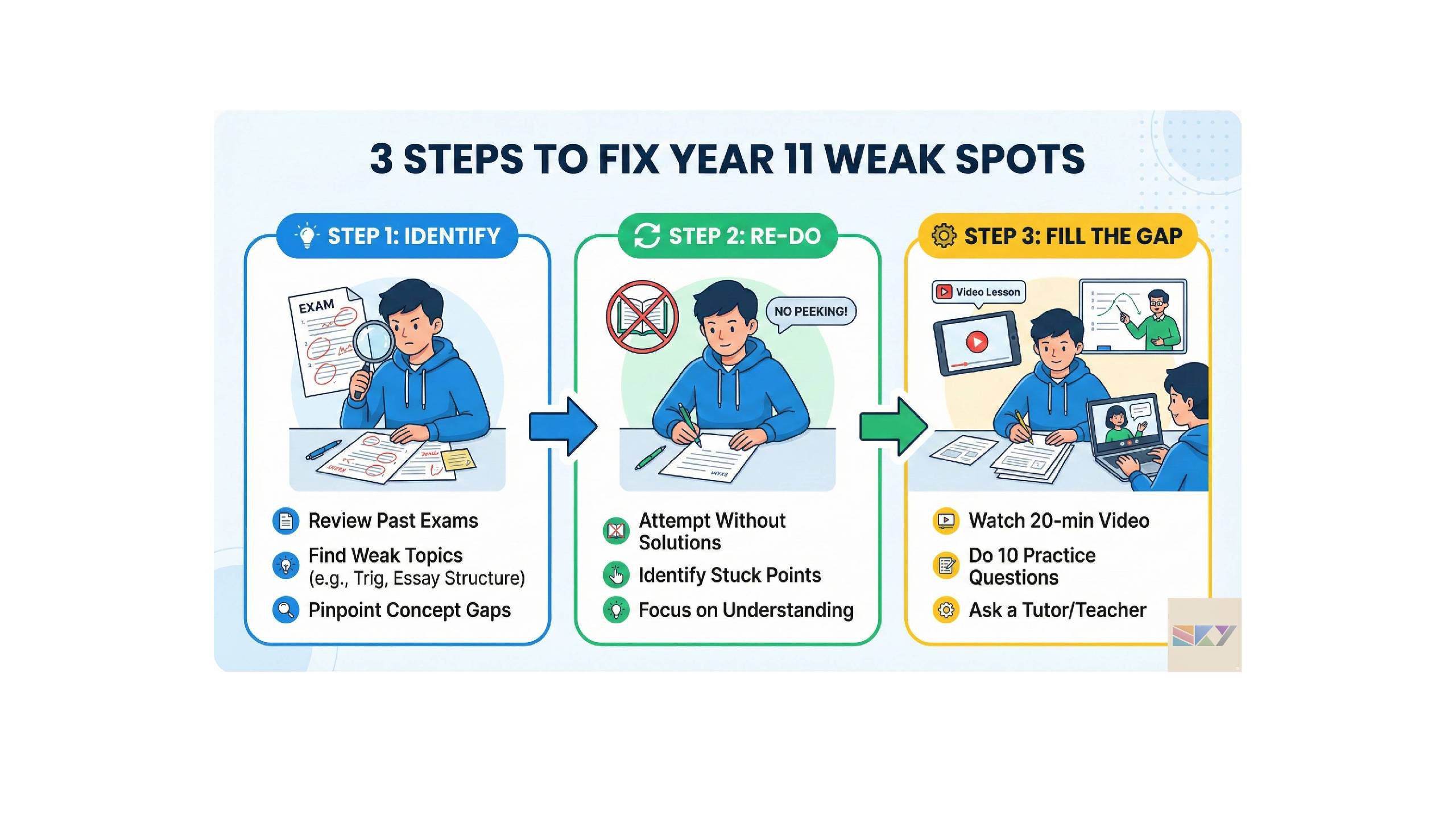
The 3-Step Fix for Year 11 Gaps
Step 1: Identify Your Biggest Weakness (15 mins)
- Look at your Year 11 final exam results
- Find the topic where you scored the lowest OR struggled the most conceptually
- Real examples from HSC:
- For Maths: Linear Relationships, Quadratic Functions, Basic Trigonometry
- For Chemistry: Atomic Structure, Bonding, Chemical Equations
- For Biology: Cell Structure & Function, DNA Replication
- For English: Close Reading, Textual Analysis, Quote Integration
Step 2: Re-do the Exam (45-60 mins)
- Sit down with your Year 11 exam and attempt it again
- Don't look at solutions first
- Identify exactly where you get stuck
- Is it a concept gap? A calculation error? Poor understanding of what the question is asking?
Step 3: Fill the Gap With Expert Guidance (1-2 Hours Over 2-3 Weeks)
Here's where most students go wrong – they try to learn the topic alone, re-reading the textbook or searching random YouTube videos. This wastes time and doesn't guarantee deep understanding.
Here's the realistic approach:
Week 1: Watch & Understand (30-45 mins)
- Watch the SKY HSC recorded lesson on your weak topic (from our archive or purchase if needed)
- Review the accompanying Theory Booklet
- Highlight concepts you don't fully understand
- Don't try to memorise – just focus on understanding the big picture
Week 2: Practice & Check (45-60 mins)
- Do 8-10 practice questions related to that topic
- Work through them slowly (don't rush)
- When you get one wrong, don't just look at the solution – understand why you got it wrong
- Re-read the relevant section of the Theory Booklet
Week 3: Ask an Expert (Unlimited 1-on-1 Sessions)
- Book a session with a SKY HSC tutor in your subject
- Bring your prepared questions and the practice problems you found challenging
- Let the tutor explain the concepts in a way that clicks for you
- Ask them to check your understanding repeatedly until it's crystal clear
Why this approach works (the science):
This method leverages Spacing Effect – the brain retains information better when learning is spread out over time rather than crammed into one session. Research shows spaced practice is 2-3x more effective than massed practice (Cepeda et al., 2006).
By spreading this across weeks, with sleep in between, your brain has time to consolidate the information into long-term memory. You're not just cramming for tomorrow's test – you're building knowledge that lasts through Year 12.
Timeline: This 1-2 hour investment spread across 3 weeks will save you 20+ hours of confusion in Year 12.
Strategy #2: Build a Sustainable Study System (Before the Burnout Hits)
The Problem
Year 12 is longer and harder than Year 11. The content is more complex. Teachers move faster. There are more assignments.
By March (just 6 weeks into Year 12), many students hit a wall. They're exhausted, their grades are dropping, and they don't understand why they're so burnt out.
The reason: They never built a system. They're just "trying to study more," which leads to unsustainable hours and emotional exhaustion.
Why This Causes Grade Decline
When you're burnt out:
- You can't focus during study sessions (your brain is too tired)
- You make careless mistakes on tests
- You procrastinate more (because studying feels painful)
- You get sick more often (stress tanks your immune system)
- Your grades naturally decline
The 3-Component System
Component 1: Weekly Study Schedule (Not a Timetable, a System)
Create a repeating weekly rhythm, not a rigid minute-by-minute timetable.
Example Schedule (Realistic for Most Year 12 Students):
- Monday: 4-5pm - Maths Practice (30 mins) + Review (30 mins)
- Tuesday: 4-5pm - Chemistry or Biology Practicals + Questions (50 mins)
- Wednesday: 4-5pm - Physics or English focused study (50 mins)
- Thursday: 4-5pm - Maths or weak subject targeted revision (50 mins)
- Friday: 3:30-4:30pm - Weekly review + plan for next week
- Sunday: 3-5pm - One 2-hour deep study block on your most challenging subject
- Rest of the week: No formal study blocks – keep weekends mostly free
Total commitment: ~5-6 hours per week of focused study, plus class time.
Key principle: Consistency beats intensity. You want to study 5 hours per week sustainably, not 15 hours one week and 0 hours the next. Sustainable habits beat heroic cramming sessions.
Component 2: Non-Negotiable Rest (This is NOT Optional)
Your brain learns and consolidates information during rest, not during study. This is backed by sleep neuroscience – during sleep, your hippocampus replays the day's learning and transfers it to long-term memory (Walker, 2017).
- Sleep: 8+ hours per night (non-negotiable)
- If you're only getting 6 hours, you're erasing the benefit of your study time
- Lack of sleep impairs memory formation, decision-making, and emotional regulation
- Exercise: 3-4x per week (even just 20-minute walks)
- Improves focus, reduces anxiety, boosts memory retention
- Social time: 2-3 evenings per week with friends (guilt-free)
- Prevents isolation and burnout
- One full day per week: Zero academic work
- Your brain needs genuine rest to reset
Students who maintain their grades treat these like exam dates – they're unmissable.
Component 3: Monthly Review & Adjustment
Every month, ask yourself honestly:
- Am I actually following this system? (Aim for 70-80% consistency)
- Are my grades staying stable or improving?
- Am I burnt out or energised?
- What's one thing I need to change?
Adjust as needed. The best study system is the one you'll actually stick to.
Need Expert Help Building Your System?
At SKY HSC College, our tutors don't just teach content – they coach you on building sustainable study systems. During our initial consultation, we work with you to:
- Assess your current study habits and energy levels
- Identify where you're losing time or focus
- Design a personalised weekly schedule that fits your life
- Build in accountability check-ins
Check out our Study Tips Guide for more practical advice on creating effective routines.
Timeline: Design this system in the first week of Year 12. It will feel rigid at first, but by Week 4, it becomes your natural rhythm.
Strategy #3: Master Active Learning (Not "Pretty Note-Taking")
The Problem
Many Year 11 students develop the habit of "studying = writing nice notes in colour."
This feels productive. It feels like learning. But it's not.
When you move to Year 12 and the content gets harder, this passive approach breaks down. You're spending 5 hours writing notes and remembering almost nothing.
Why This Causes Grade Decline
Passive learning (reading, rewriting notes, highlighting) uses your short-term memory. This feels good in the moment, but research shows that after 24 hours, you forget 80% of what you passively read (Ebbinghaus Forgetting Curve).
When you sit down for a test or exam, you can't remember the material, even though you spent so many hours on it.
Result: Your grades drop because you're not actually retaining information.
The Active Learning Framework (3 Techniques)
Technique 1: Learn Before You Write
Instead of: Read chapter → Write notes → Do practice questions
Do this instead:
- Skim the chapter title/headings (2 mins)
- Do 3 practice questions on that topic without knowing the answer (10-15 mins)
- Read the chapter to fill gaps (10 mins)
- Do 5 more practice questions (15 mins)
This forces your brain to struggle first, which activates Active Recall – the most powerful learning mechanism in cognitive psychology (Roediger & Karpicke, 2006). When you struggle to retrieve information, your brain marks it as important and stores it more strongly.
Technique 2: The 1-Page Summary (Without Looking)
After each lesson:
- Close your textbook and notes immediately
- Summarise everything you just learned on ONE page
- Include: key concepts, formulas, real-world examples
- Don't look at your notes while you do this
This is retrieval practice – you're forcing your brain to pull information from memory rather than copying it from the page. This creates stronger, more flexible memories.
Then, compare your summary to the textbook. What did you forget? Add it in a different colour. This metacognitive step helps you identify exactly what you don't know yet.
Technique 3: Teach It Out Loud (With Real-Time Feedback)
After learning a concept:
- Explain it to your parents, a friend, or even your dog
- Use your own words (not the textbook's words)
- If you can't explain it clearly, you haven't learned it yet
This forces you to translate technical information into plain language – a powerful learning strategy.
But Here's Where SKY HSC Makes a Real Difference:
Teaching concepts out loud is powerful – but teaching to a real expert who can correct you immediately is transformative.
In our small-group classes, you regularly explain concepts to your tutor and classmates. Your tutor provides real-time corrective feedback, catches misconceptions before they become entrenched, and deepens your understanding through targeted follow-up questions.
You leave each lesson knowing exactly what you understand deeply and what needs more work. This builds genuine confidence, not false confidence.
For more on effective learning techniques, check out our Exam Preparation Guide.
Timeline: Switch to active learning from Week 1 of Year 12. It will feel slower at first (and it is – by design). But by Week 4, you'll notice you're retaining information much faster than you ever did with passive note-taking.
The Grade Decline Isn't Inevitable – It's Preventable
Thousands of Year 12 students experience a grade drop in their first term. But you don't have to be one of them.
If you:
- Fix your Year 11 weak spots before Year 12 starts (1-2 hours over 3 weeks)
- Build a sustainable study system that doesn't burn you out (5-6 hours per week)
- Switch to active learning instead of passive note-taking (different technique, not more hours)
...you won't just prevent a grade decline. You'll actually improve your grades.
The students who follow these 3 strategies consistently report that their grades in Term 1 Year 12 are 5-15% higher than their Year 11 average. More importantly, they feel less stressed because they have a system that works.
The secret isn't working harder. It's working smarter, right from the start.
Ready to Make the Year 11→12 Transition Smooth?
Here's the reality: these strategies work even better with expert guidance and accountability.
At SKY HSC College, we help students execute all 3 strategies from Day 1 of Year 12:
What We Offer:
✅ Lifetime Access to Recorded Lessons
If you're enrolled with us, you have permanent access to every lesson recording in your subject until graduation. Missed a lesson? Struggling with a concept? Rewatch anytime – no additional cost.
✅ Video Purchase + Unlimited 1-on-1 Sessions (For Specific Weak Topics)
- Purchase the exact lesson videos covering your Year 11 gaps
- Get the accompanying Theory Booklet with comprehensive notes
- Book unlimited 1-on-1 sessions with your subject specialist
- Master each topic completely before moving forward
- No artificial time limits – learn until you truly understand
✅ Personalised Study System Coaching
We design a sustainable, accountability-based study schedule tailored to your subjects, energy levels, and social life. Not a one-size-fits-all timetable – a system built for you.
✅ Real-Time Feedback on Active Learning
Small-group classes where you practice explaining concepts out loud to real experts. Misconceptions get corrected immediately. Understanding gets deeper. Confidence builds naturally.
✅ Continuous Progress Monitoring
Weekly check-ins to ensure you're staying on track, grades are improving, and you're not burning out. We adjust the system if needed.
The Results:
Our students report:
- 5-15% higher grades in Term 1 Year 12 (vs. their Year 11 average)
- Significantly less stress and anxiety
- Actual mastery of content (not just memorisation)
- Confidence going into HSC exams
Don't navigate this transition alone. You deserve expert guidance.
Take Action Today
Option 1: Start With a Free Trial Lesson
[Book Your Free Trial] – Experience our teaching method firsthand. No obligation, no pressure.
Option 2: Purchase Video + 1-on-1 Sessions for Specific Topics
If you missed lessons mid-year or need to fill Year 11 gaps, this is your solution. Get the video, Theory Booklet, and unlimited 1-on-1 support for one focused topic. [Browse Our Lesson Videos & Packages]
Option 3: Enrol in Year 12 Classes for Full Support
Join our small groups and get the complete experience: recorded lessons, live coaching, study system guidance, and real-time feedback on active learning. [View Year 12 Programs]
The transition from Year 11 to Year 12 is challenging, but you don't have to figure it out alone.
We've helped hundreds of students make this leap successfully. Many of them improved their grades by 10-20% in their first term because they had the right strategy, the right system, and the right support.
Your Year 12 journey starts now. Let's make it count.
[Book Your Free Trial Today] → https://skyhsc.com/trial No credit card needed. Just a conversation about your goals and how we can help.
Written by Marc, SKY HSC College
29 December 2025
P.S. Whether you join us or not, please implement the 3 strategies above. Your future self will thank you for the effort you put in right now. The science backs these methods – they work. Now it's up to you to take action.