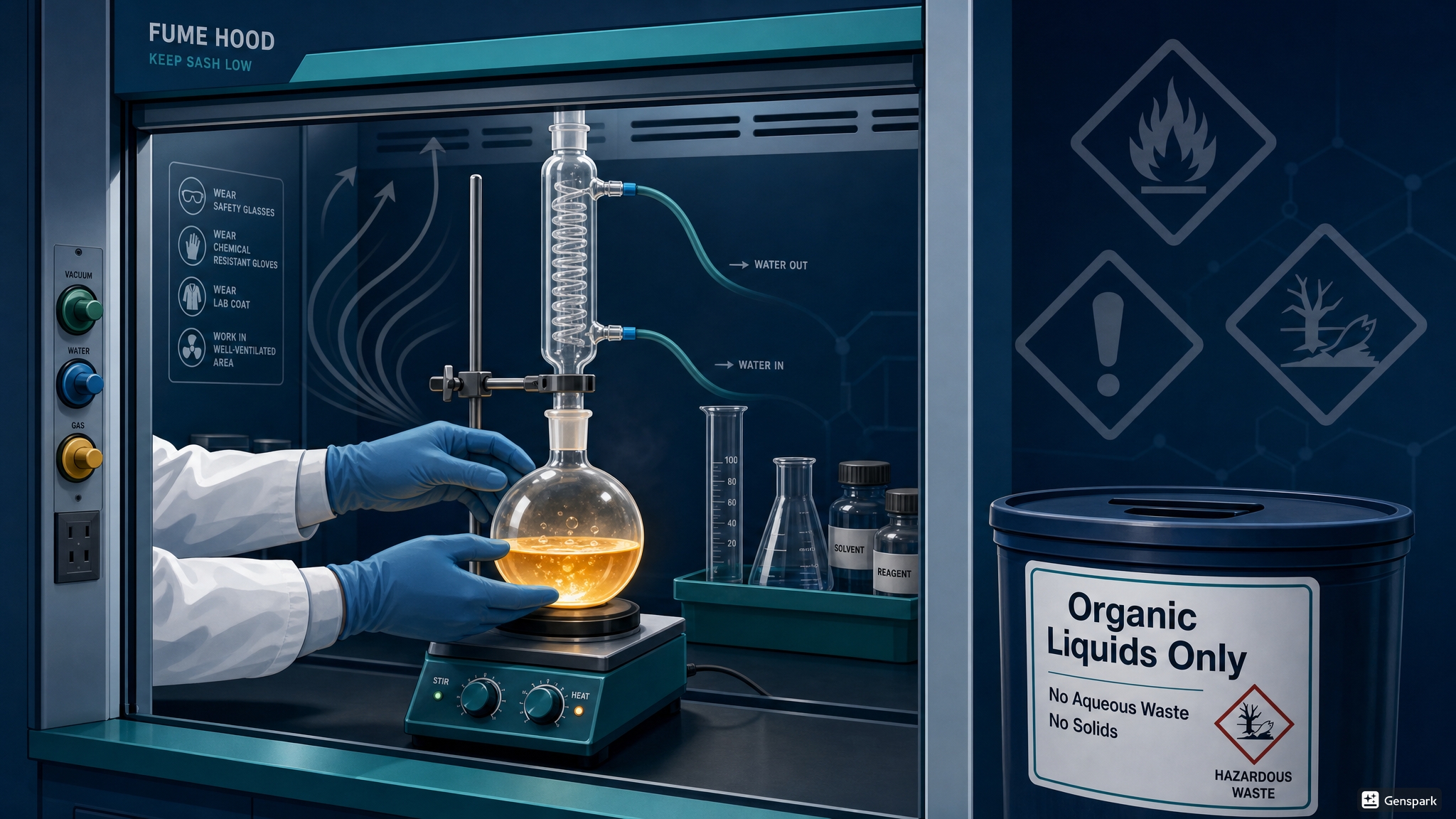
HSC Chem Mod 7: Safe Handling & Disposal — Band 6 Exam Guide
HSC Chemistry Module 7: Safe Handling & Disposal of Organic Substances — The Band 6 Exam Guide
By the SKY HSC College Chemistry team — 25+ years coaching Sydney HSC students into Band 6. Last reviewed: May 2026 against the NESA Stage 6 Chemistry Syllabus and 2019–2025 HSC + CSSA + Catholic + Independent + major-school trial papers.
This dot point shows up in every HSC and trial paper, in some form, every year. The 2025 HSC tested it via a phosgene safety question (Q30); the 2024 HSC tested it via investigation procedures; CSSA, Catholic, and Independent trials all carry at least one question on it. Most students lose marks here not from weak chemistry but from writing what looks like a safety answer instead of what NESA markers actually reward.
We've reverse-engineered marking guidelines from the 2019–2025 NESA HSC papers, the major school trials, and NESA Notes from the Marking Centre. This guide turns those patterns into the exact wording, structure, and chemistry that scores Band 6 — every time.
⏱️ Pick your study window
Time you have Read this ⚡ 5 min Sections 1–2 (Syllabus Decoded + TL;DR) ⏱️ 20 min + Section 3 (Verb Strategy) + Section 11 (Cheat Sheet) 📚 1 hour Everything — every Q pattern, every Band 6 sentence, every trap
📱 Prefer to study interactively? This guide is also available as a fully interactive web app — with searchable content, zoomable SVG diagrams, an Exam Answer Builder for the 4 pillars, MCQ self-tests, and instant-copy flashcards.
👉 Open the interactive Module 7 IQ4 study tool
Works on phone, tablet, and laptop. No login required.
🎯 What this guide gives you
By the end, you will be able to:
- ✅ Quote the NESA dot point and decode every word into what markers expect
- ✅ Identify the four hazard categories of organic substances and the molecular reason behind each
- ✅ Justify any precaution by chaining Property → Hazard → Precaution → Why — the marker-keyword pattern
- ✅ Read a Safety Data Sheet (SDS) the way the 2025 HSC asked you to
- ✅ Write Band 6 answers for every question pattern from 2-mark short response to 6-mark assess
- ✅ Avoid the seven traps that cost students 1–3 marks per long question
🗺️ Inside this guide
| # | Section | What you'll get |
|---|---|---|
| 1 | The Syllabus Decoded | The dot point as your first exam question |
| 2 | TL;DR | The whole topic in 90 seconds |
| 3 | NESA Verb Strategy | Verb-by-verb keyword decoder |
| 4 | Property → Hazard → Precaution | The master chain that powers every answer |
| 5 | SDS Deep-Read | The 4-step protocol for SDS-stimulus questions |
| 6 | Disposal & Spill Response | 3 rules + the calm-fast spill sequence |
| 7 | Q&A with Mark-by-Mark Scaffolds | 8 questions across every NESA pattern |
| 8 | Band 6 Boosters | The extension layer |
| 9 | Common Mistakes | 7 traps that cost marks |
| 10 | Cross-Module Connections | How this dot point links to Mod 4, 5, 6, 8 |
| 11 | Cheat Sheet | Last-minute revision tables |
| 12 | Recall Quiz | 10 questions with answers |
| 13 | NESA Verbs Card | Print-friendly quick reference |
1. The Syllabus Decoded — What NESA Actually Wants
NESA writes dot points in exam-question grammar. Decode the wording → predict every variation NESA can ask.
📜 The dot point, verbatim
"Describe the procedures required to safely handle and dispose of organic substances."
— NESA Stage 6 Chemistry Syllabus (2017), Module 7: Organic Chemistry — NESA outcomes CH12-13, CH12-14, CH12-15 (Legacy national curriculum: ACSCH075)
🔍 Word-by-word — read the syllabus like an exam question
Here's something most students miss: NESA writes dot points using the same grammar they use for exam questions. That means if you decode the dot point phrase by phrase, you've already predicted every variation NESA could ask you on test day. Let's go through each phrase and see exactly what it's telling you.
"Describe" — what is this verb really asking?
Describe is NESA's floor verb for this dot point. It means: provide the characteristics and features of the procedures. You don't need to debate them, you don't need to weigh them up — you just need to clearly state what they are and link each one to a property of the substance.
But here's the catch: NESA can swap out Describe for a harder verb at any time, and the same content suddenly demands a different structure. Watch how the question changes shape as the verb gets harder:
| Verb | What NESA wants | What changes in your answer |
|---|---|---|
| Identify | Just name the procedures | A list — minimal explanation |
| Outline | Briefly sketch them | Short bullet-style main points |
| Describe | Characteristics + features | Property → precaution sentences |
| Explain | Cause and effect | Add "because…" / "as a result…" |
| Justify | Defend with evidence | Add "this is supported by…" |
| Discuss | Identify issues for AND against | Acknowledge both sides |
| Assess | Make a judgement of value | Close with "On balance, …" |
| Evaluate | Judgement based on criteria | Weigh X against Y explicitly |
⚠️ The verb trap. The single most common mark-loss pattern we see is students writing an Assess answer when the question says Describe (over-shoots, wastes time you needed for other questions) — or a Describe answer when the question says Assess (under-shoots, capped at roughly half marks). Always circle the verb on the exam paper before you start writing. It takes two seconds and saves you marks every time.
"the procedures required" — why is this word plural?
Look at that "s" at the end of procedures. That's not an accident. NESA chose plural for two specific reasons, and both have direct consequences for your mark:
1. Multiple precautions are expected, not one. A 4-mark answer needs roughly four distinct procedures. A 5-mark answer needs five. A 6-mark answer needs six (or four with deeper justification + judgement). Writing one beautifully detailed precaution still caps you at 1 mark — markers can't reward content that isn't there.
2. Sequencing matters. The word "required" implies these procedures must happen in a specific order — handling before disposal, neutralisation before sink rinse, naked-flame removal before opening a flammable solvent. Markers reward answers that show this awareness with sequencing words like "first, …", "before…", "then, …".
💡 Quick self-check. After you've written your answer, count the distinct procedures. If your "4-mark" answer only has 2 procedures, you've underwritten by 2 marks. Go back and add more — link each new procedure to a different molecular property.
"to safely handle" — what does "handle" actually cover?
This phrase covers everything that happens before the experiment starts and during the experiment runs — basically, the entire time the substance is "alive" in your hands. NESA can test any of these five sub-domains:
- PPE selection — Which gloves? (Nitrile vs latex matters — see §4.4.) Which goggles? (Wrap-around vs basic.) Lab coat?
- Equipment selection — Fume hood vs bench? Water bath vs heating mantle vs Bunsen? Reflux condenser? Anti-bumping granules?
- Technique — Adding acid to water (never the reverse). Pouring slowly to avoid static discharge. Keeping the work area clear.
- Environment — Is the fume hood operating? Are naked flames eliminated? Are incompatible chemicals stored away?
- Storage — Flammable cabinet vs general bench? Separated from oxidisers? Labelled with name, concentration, date?
A typical 5-mark "describe handling" answer picks 3–4 of these sub-domains and links each one to a specific molecular property of the substance. That's how you get marks across multiple categories without padding.
"and dispose" — what changes after the experiment?
The substance has done its job. But the hazards don't disappear when you stop using it — they just change form (residual solvent in glassware, contaminated paper towel, mixed-waste bottle). That's what "and dispose" covers: everything that happens after the experiment finishes.
Four moves to know:
- Container selection — "Organic Liquids Only" vs "Aqueous Waste" vs "Halogenated Organic" vs "Heavy Metals". The label on the bottle is part of the answer.
- Segregation — Never mix organic with aqueous. Never mix halogenated with non-halogenated. Heavy metals always separate.
- Sink-vs-container decision — When can you go down the sink? Almost never for organics. The one acceptable exception (dilute, neutralised carboxylic acid) is a Band 6 detail we cover in §6.
- Spill response — Different sequences for lab spill vs body spill. NESA loves to ask this as a 1-mark add-on.
🎯 Why NESA tests disposal so often. It separates students who memorised PPE checklists from students who actually understand that handling and disposal are equally weighted parts of safe lab practice. Don't shortchange the disposal half of any handling-and-disposal question — it's where easy marks are won and lost.
"of organic substances" — which substances will NESA actually pick?
This is where students get caught out. "Organic substances" is a huge class. NESA could name any of these in tomorrow's exam:
- Hydrocarbons — alkanes (hexane, octane), alkenes (hex-1-ene, ethene), alkynes
- Alcohols — ethanol, methanol, 1-butanol, propan-2-ol
- Carboxylic acids — ethanoic acid, methanoic acid, propanoic acid
- Esters — ethyl ethanoate, methyl propanoate
- Ethers — diethyl ether (notoriously low flashpoint of −45 °C!)
- Halogenated solvents — dichloromethane (DCM), chloroform
- Ketones, amines, and others — propanone (acetone), methylamine
And in the 2025 HSC, NESA deliberately pushed the boundary by naming phosgene (COCl₂) — a gas-phase, hydrocarbon-derived industrial reagent that most students had never studied. The students who scored full marks didn't panic. They applied the same chain — highly toxic gas → fume hood + respiratory protection — to an unfamiliar substance.
🔑 The big lesson. Don't memorise procedures for one specific substance and hope NESA picks it. Memorise the chain — Property → Hazard → Precaution → Why — so you can apply it to anything NESA throws at you, including substances you've never seen before. That's what the verb "describe" is really testing: not your memory of hexane, but your fluency with the chain.
🧠 What you actually need to master — the eight skills
To handle any NESA question on this dot point, be fluent in:
1. The four hazard categories. Volatile/flammable · Corrosive · Toxic/fat-soluble · Reactive (e.g., conc. H₂SO₄, oxidisers + organics).
2. The molecular reason behind each hazard. Volatile because non-polar chains have weak dispersion forces ⇒ low boiling point. Corrosive because –COOH donates H⁺. Fat-soluble because non-polar molecules cross lipid membranes. Linking the molecular reason is what separates a 2/3 from a 3/3.
3. Seven standard precautions and the property each addresses. Fume hood (volatile/toxic vapour) · No naked flame (flammable) · Water bath / heating mantle (flammable when heated) · Reflux + anti-bumping granules (volatile reactants under prolonged heat) · Nitrile gloves (corrosive, fat-soluble — latex is permeable to non-polar solvents) · Wrap-around goggles (corrosive, splash) · Labelled storage cabinet (incompatible classes).
4. Four disposal pathways. "Organic Liquids Only" container · "Aqueous Waste" container (or sink only after neutralisation/dilution) · "Heavy Metals" container · separate "Halogenated Organic Waste" container.
5. The 8-section SDS structure — and which sections markers test most often. Section 2 (Hazard Identification) and Section 13 (Disposal Considerations) are the high-frequency targets.
6. GHS hazard pictograms and H-statements. H225 (highly flammable), H315 (skin irritation), H336 (drowsiness), H411 (toxic to aquatic life). Trial papers, school mock exams, and laboratory investigations frequently print these and expect you to translate them into precautions — even though the 2019–2025 NESA main HSC has not yet used an SDS extract directly as stimulus. The decoding skill is high-leverage for trial preparation regardless.
7. The spill-response sequence — different sequences for lab spill vs body spill.
8. The single-sentence marker pattern — memorise this skeleton:
"[Substance] is [property] because [molecular reason], so
 [precaution] is required to [prevent specific consequence]."
💡 That sentence works for any organic substance, any hazard, any mark count. It is the single most valuable line in this guide. Memorise it.
🎯 Question patterns NESA actually asks (2019–2025 evidence)
| Pattern | Marks | Verb | Real example |
|---|---|---|---|
| Single substance — hazards + precautions | 2 | Identify / Describe | 2022 HSC simulated: hex-3-ene |
| Single substance — full handling procedure | 3 | Describe | 2023 trial: diethyl ether |
| Multi-substance investigation | 4 | Describe | Esterification: ethanol + ethanoic acid + H₂SO₄ |
| Investigation + chemical equation | 5 | Describe + include equation | Hexane combustion |
| SDS stimulus interpretation | 2–3 | Identify / Describe | NESA pattern across years |
| Strict procedures justification | 5–6 | Assess / Evaluate | 2020 trial extended response |
| Specific gas-phase reagent | 2–3 | Justify a named precaution | 2025 HSC Q30: phosgene |
NESA marker feedback — what they consistently reward and reject
Pulled from NESA Notes from the Marking Centre and our own marking observations across 2019–2025.
| ✅ Rewarded | ❌ Rejected (or capped at 1 mark) |
|---|---|
| Correct equipment terminology — "fume hood", "reflux condenser", "heating mantle" | Generic "wear PPE" or "be careful" |
| Linking precaution to a specific chemical's property | "Safety glasses" alone (no chemical link) |
| Distinguishing precautions for people vs environment | "Gas cabinet" instead of "fume hood" (incorrect terminology) |
| Specific GHS H-statement references when an SDS is given | "Don't pour down the drain" without naming the correct waste container |
| Justification — the why behind every precaution | Listing precautions without justification |
💡 Why this dot point appears every year. It tests three things at once: laboratory skills, syllabus content, and exam-craft. Build the chain — Property → Hazard → Precaution → Why — and you've earned a full mark on every question pattern above.
2. TL;DR — The Dot Point in 90 Seconds
🪧 The whole guide, compressed.
Every safety answer must link a molecular property → a specific precaution → a specific justification. "Wear PPE" alone earns nothing. "Chemical-resistant nitrile gloves because ethanoic acid's –COOH group donates H⁺, making it corrosive to skin" earns the mark.
Four hazard categories drive every answer:
| Hazard category | Trigger | Precaution combo | |
|---|---|---|---|
| 🔥 | Volatile / flammable | Low BP, weak dispersion forces | Fume hood + no naked flame + water bath |
| ⚗️ | Corrosive | –COOH or strong oxidiser | Full skin-protection PPE — wrap-around goggles + nitrile gloves + lab coat |
| 🧪 | Toxic / fat-soluble | Lipid-permeable | Fume hood + nitrile gloves + soap-wash hands |
| 💥 | Reactive | e.g., concentrated H₂SO₄ | Add acid to water, slowly, with stirring |
Disposal: never down the sink; segregate organic / aqueous / heavy-metal / halogenated waste into labelled containers. SDS hazard pictograms and H-statements are stimulus material — expect them, decode them, write the matching precaution.
3. NESA Verb Strategy
The same dot point can be tested with eight different verbs. Match the verb, match the structure.
Verb decoder
| Verb | NESA glossary | Justify? | Judgement? | 🎯 Marker keyword |
|---|---|---|---|---|
| Identify | Recognise and name | ❌ | ❌ | "is", "are" |
| Describe | Provide characteristics and features | optional | ❌ | "is", "has the property" |
| Outline | Sketch in general terms | ❌ | ❌ | "the main…" |
| Explain | Relate cause and effect | ✅ | ❌ | "because", "as a result" |
| Justify | Support an argument with evidence | ✅ | ❌ | "this is supported by…" |
| Discuss | Identify issues + points for/against | ✅ | optional | "however", "by contrast" |
| Examine | Inquire into | ✅ | optional | "consider", "in addition" |
| Assess | Make a judgement of value | ✅ | ✅ must | "on balance", "ultimately" |
| Evaluate | Make a judgement based on criteria | ✅ | ✅ must | "weighing X against Y" |
🎯 The judgement clincher — your assess / evaluate closer
"On balance, strict procedures are essential — the molecular features that make organic substances industrially valuable (volatility, reactivity, lipid-solubility) are the same features that make them hazardous if mishandled. The evidence indicates these procedures are not optional but foundational to ethical lab practice."
Memorise the structure. Steal the connectives:
- "On balance," ← the judgement signal
- "the evidence indicates" ← grounded confidence
- "foundational to" ← criterion-based valuation
⚠️ The single biggest 6-mark mark loss. Forgetting the judgement on assess / evaluate caps you at 5/6, automatically. Catch yourself before you submit.
4. The Property → Hazard → Precaution Master Chain
Ethanol, hexane, ethanoic acid, and water can all sit in identical-looking beakers. One will burn your skin. One will ignite if there's a Bunsen across the room. One will poison fish for years if you tip it down the sink. The whole dot point is one move.
The chain, visualised
   PROPERTY              HAZARD               PRECAUTION             WHY
─────────────       ─────────────────      ───────────────       ──────────────
 Volatile        →   Inhaled vapours    →   Fume hood          →   Negative
 (low BP, weak       Ignitable cloud        No naked flame         pressure pulls
 dispersion          near the bench         Water bath only        vapour from
 forces)                                                            breathing zone
─────────────       ─────────────────      ───────────────       ──────────────
 Flashpoint      →   Ignitable at room  →   Heating mantle      →  Eliminates
 < 23 °C            temperature             Reflux + granules      ignition source
─────────────       ─────────────────      ───────────────       ──────────────
 Corrosive       →   Skin / eye burns   →   Nitrile gloves      →  Forms a
 (–COOH                                     Wrap-around            chemical-
 donates H⁺)                                goggles                resistant
                                                                    barrier
─────────────       ─────────────────      ───────────────       ──────────────
 Fat-soluble     →   Skin absorption    →   Nitrile gloves      →  Latex is
 (non-polar          Bioaccumulation        Soap-wash hands        permeable to
 organics                                                           non-polar
 cross lipid                                                        solvents
 membranes)                                                         within minutes
─────────────       ─────────────────      ───────────────       ──────────────
 Non-polar       →   Floats on water    →   "Organic Liquids    →  Would form
 / immiscible       Contaminates           Only" container         toxic surface
                    waterways                                       layer in sink
─────────────       ─────────────────      ───────────────       ──────────────
 Reactive        →   Violent exotherm   →   Add acid TO water   →  Larger water
 (conc. H₂SO₄)       (~80 kJ mol⁻¹)         slowly, stirring       volume absorbs
                                                                    heat safely
4.1 🔥 Volatile and flammable — and the magic number 23 °C
If you can smell it, it can probably burn.
Most organic molecules are held together by weak dispersion forces between non-polar carbon chains. Very little energy lifts them into the vapour phase. Vapour + a spark = combustion.
🔑 Flashpoint = the lowest temperature at which a liquid forms an ignitable mixture in air. Under the GHS classification used in NESA-aligned SDSs, flashpoint < 23 °C earns the highly flammable label.
The reference table you should memorise
| Substance | Flashpoint | At room temp (25 °C)… |
|---|---|---|
| Diethyl ether | −45 °C | 🔴 Vapour ignitable; never use a Bunsen anywhere in the room |
| Hexane | −22 °C | 🔴 Already ignitable — fume hood essential |
| Propanone (acetone) | −20 °C | 🔴 Already ignitable |
| Ethanol | 13 °C | 🔴 Already ignitable |
| 1-Butanol | 35 °C | 🟡 Safer alternative for many investigations |
| Ethanoic acid | 39 °C | 🟡 Safe at room temp (still corrosive — see §4.3) |
📌 Why this matters in the exam. A 2-mark MCQ pattern gives you a chemical's hazard label and asks for the most important precaution. The trap answer is "wear gloves" — gloves don't stop vapour ignition. Fume hood + no naked flames is the answer when flashpoint is below room temp.
4.2 🌡️ Heating organics — never on a Bunsen
NEVER                 USE INSTEAD                     WHY
──────                ────────────                    ────────────
Bunsen burner    →    Water bath (≤ 95 °C)            No flame, controllable
(~1500 °C, ignites    OR
any organic vapour)   Heating mantle (electric)
                      OR
                      Reflux + anti-bumping granules  Traps volatile reactants;
                      (for prolonged heat)             smooth boiling, no
                                                       eruption
💡 Anti-bumping granules are small porous ceramic chips. They nucleate vapour bubbles smoothly. Without them, superheated liquid eruption ("bumping") splashes hot reagent out of the flask.
4.3 ⚗️ Corrosive — carboxylic acids and concentrated sulfuric
Ethanoic acid's –COOH group donates H⁺ in solution, making the molecule acidic and corrosive at high concentrations. It reacts with the keratin in skin and the proteins in eye tissue.
✅ Precaution. Full skin-protection PPE — chemical-resistant nitrile gloves, wrap-around safety goggles, and lab coat (long sleeves) to cover all exposed skin. Latex gloves are not acceptable for organic substances — they are permeable to many non-polar solvents within minutes. First aid for skin contact: rinse 10–15 minutes with running water, then wash with mild soap.
4.4 🧪 Toxic and fat-soluble — the silent hazard
Many small organic molecules are lipid-soluble — they dissolve into the fatty layer of skin, mucous membranes, and ultimately fat tissue and the bloodstream. Brief skin exposure to hexane, chloroform, or dichloromethane causes systemic effects (dizziness, headache).
Worse, fat-soluble organics resist breakdown and bioaccumulate in the food chain. Small amounts in plankton concentrate into measurable doses in tuna and seabirds. This biomagnification is why disposal matters as much as handling.
✅ Precaution. Even with gloves, wash hands with soap (not water alone — water cannot lift a non-polar contaminant) before leaving the lab, eating, or touching your face.
4.5 💥 Concentrated H₂SO₄ — the catalyst that fights you
WRONG                                  RIGHT
─────                                  ─────
   Water                                  Acid
     │                                      │
     ▼                                      ▼
  ┌─────┐  ← splatters!                  ┌─────┐  ← absorbs
  │ Acid │     superheated               │Water│      heat
  └─────┘     interface                  └─────┘      safely
Mixing conc. H₂SO₄ with water releases ~80 kJ per mole of acid. Water is less dense than concentrated H₂SO₄, so if you pour water onto acid, the water floats; the interface superheats and splatters acid violently.
🔑 The rule. Always add acid to water — slowly, in small volumes, with stirring. Never the reverse.
4.6 🗄️ Storage
Keep flammable liquids in a dedicated flammable-liquid cabinet, separated from oxidising agents (KMnO₄, K₂Cr₂O₇, conc. HNO₃). Oxidisers + organics can spontaneously ignite. Label every container with name, concentration, date prepared, and hazard class.
4.7 ⚡ Static electricity and earthing
When pouring large volumes of low-flashpoint solvents (hexane, diethyl ether), static charge can build up between containers and discharge as a spark. Industrial-scale work uses earthed metal containers; in school labs, pour slowly and avoid plastic funnels with very low-flashpoint solvents.
🧠 Band 6 Booster — Vapour density
Hexane vapour is ~3× denser than air and pools at floor level. An overhead extraction fan won't disperse it. This is why fume hoods (with bottom-edge intake) are required, not just "ventilation". Mention this if a question gives a "fume hood is not available" scenario — it shows you understand why fume hoods specifically are required.
5. SDS Deep-Read — Extracting Marks from a Stimulus
Every chemical has a Safety Data Sheet. SDS-style stimulus is common in trial papers and school mock exams and is a frequent in-class assessment task — though our 2019–2025 audit of NESA main HSC papers shows no confirmed SDS extract used directly as stimulus (the 2025 HSC Q30 phosgene stimulus was a text description, not an SDS). The 4-step decode protocol below still applies whenever you encounter SDS material.
The 8-section SDS structure (high-frequency targets in bold)
| # | Section | What it tells you | 🎯 Hexane example |
|---|---|---|---|
| 1 | Identification | Name, supplier | n-Hexane |
| 2 | Hazard Identification | GHS hazard classes + H-statements + pictograms | H225, H315, H336, H411 |
| 3 | Composition | Mixture or pure | ≥ 95% n-hexane |
| 4 | First Aid | Inhalation / ingestion / skin / eye | Inhaled: fresh air, rest; medical advice |
| 5 | Fire Fighting | Suitable extinguisher | CO₂, dry chemical; not water jet |
| 6 | Accidental Release | Spill response, containment | Absorb on inert; transfer to organic-waste |
| 7 | Handling and Storage | PPE, ventilation, incompatibilities | Fume hood; nitrile; flammable cabinet |
| 8 | Exposure Controls | Recommended ventilation + airborne-exposure limits | "Use under fume hood; avoid prolonged inhalation" |
| 9 | Physical / Chemical Properties | b.p., flashpoint, density | b.p. 69 °C; fp −22 °C; ρ 0.66 g mL⁻¹ |
| 10 | Stability and Reactivity | Incompatibilities | Strong oxidisers |
| 11 | Toxicology | LD₅₀, target organs | Inhalation toxicity; nervous system |
| 12 | Ecology | Aquatic toxicity | Toxic to aquatic life, long-lasting |
| 13 | Disposal Considerations | Waste classification | Licensed organic-liquid waste contractor |
| 14–16 | Transport / Regulatory / Other | Shipping, certifications | (rarely tested at HSC) |
🚦 GHS hazard pictograms — the visual language
| Pictogram | Meaning | Typical organic example |
|---|---|---|
| 🔥 Flame | Flammable | Ethanol, hexane, propanone |
| ❗ Exclamation | Skin irritant / acute toxicity / drowsiness | Dilute ethanoic acid, 1-butanol |
| ☠️ Skull and crossbones | Acute toxicity (high) | Phosgene, methanol (high dose) |
| 🐟 Dead tree and fish | Hazardous to aquatic environment | Hexane, halogenated solvents |
| 🧪 Test tube on hand | Corrosive | Conc. ethanoic acid, conc. H₂SO₄ |
🛠️ The 4-step protocol for any SDS-stimulus question
   Step 1                Step 2               Step 3              Step 4
 ─────────────       ─────────────────     ─────────────       ──────────────
  Quote the      →    Translate to     →   Prescribe a    →   Justify the
  H-statement         a property           matching            precaution
  (e.g., H225)        (highly              precaution
                      flammable)           (fume hood)
📌 The protocol in action (3-mark answer in 3 sentences)
"The substance has H225 (highly flammable) and H411 (toxic to aquatic life). Because the flashpoint is below room temperature, vapour is ignitable on the bench, so all naked flames must be eliminated and the substance handled in a fume hood. Because it is toxic to aquatic life, surplus reagent must go into the 'Organic Liquids Only' container — never the sink."
💡 Steal the structure. Quote → translate → prescribe → justify.
6. Disposal & Spill Response
The three rules of disposal
🚫 Rule 1 — Never pour organics down the sink.
Most are non-polar and immiscible with water. They form a toxic surface layer that travels through the plumbing into stormwater drains and waterways, where they coat aquatic organisms and persist for years.
🏷️ Rule 2 — Use the correct labelled container.
Waste type Container Organic liquids (alkanes, alkenes, alcohols, esters) "Organic Liquids Only" Aqueous / inorganic "Aqueous Waste Only" — or sink, if neutralised, dilute, and non-toxic Heavy-metal salts (Cr, Pb, Hg) "Heavy Metals Only" Halogenated solvents (DCM, chloroform) Separate "Halogenated Organic Waste" stream
🔄 Rule 3 — Segregate everything.
Organic from aqueous. Halogenated from non-halogenated. Heavy metals separately. Close every lid after every transfer to prevent vapour build-up in the cabinet.
🧠 Band 6 Booster — The acceptable "down the sink" exception
Dilute carboxylic acid (e.g., < 0.1 M ethanoic acid) may be neutralised with sodium bicarbonate and rinsed to the sink with excess water. This is what NESA marking guidelines accept for dilute aqueous-organic mixtures. Knowing the exception signals deep understanding — pure organic phase still goes to the organic container.
Spill response — fast, calm, sequenced
General lab spill (< 50 mL volatile organic)
   ① Notify teacher
        ↓
   ② Eliminate ignition sources (Bunsens off, no flame nearby)
        ↓
   ③ Transfer spill to a SHALLOW VESSEL inside an OPERATING FUME HOOD
      (shallow = max surface area = fastest evaporation;
       fume hood extracts vapour)
        ↓
   ④ Dispose of contaminated paper towel as labelled organic-solid waste
Larger spill (> 50 mL)
💡 Lay a perimeter of inert absorbent (vermiculite, sand, or commercial spill kit) around the spill before clean-up. This prevents migration to drains.
Spill on a person
   ① Remove contaminated clothing immediately
        ↓
   ② Flood affected area with running water for 10–15 minutes
        ↓
   ③ Wash with soap
        ↓
   ④ Keep eye protection on if face was affected
        ↓
   ⑤ Seek medical attention if symptoms persist
⚠️ Speed matters. Organics are fat-soluble; absorption rate climbs with contact time.
7. Q&A — Mark-by-Mark Scaffolds
Each question shows: verb decomposition → what markers want → blank scaffold → filled exemplar → mark-by-mark allocation. Steal the structure of every answer; replace the chemistry.
Q1 — Single substance, hazards + precautions
▮▮ 2 marks [Composite NESA-style question, modelled on 2022 HSC simulated and 2024 trial patterns]
Q. Hex-3-ene is to be used in a laboratory investigation. Identify TWO hazards associated with this substance and describe a suitable precaution for each.
🔍 Verb decomposition
Identify + Describe. Two hazards required. Each must be paired with a precaution. Generic "wear PPE" earns nothing.
📝 Blank scaffold
Hex-3-ene is [hazard 1] because [molecular reason], so [precaution 1].
It is also [hazard 2], requiring [precaution 2].
📌 Filled Band 6 answer
Hex-3-ene is volatile and highly flammable (flashpoint < 23 °C, weak dispersion forces between non-polar chains), so it must be kept away from naked flames, with any heating performed in a water bath rather than a Bunsen burner. It is also toxic by inhalation, so it must be handled in an operating fume hood to prevent exposure to vapour.
📊 Mark allocation
▮ 1 mark — flammability + flame precaution
▮ 1 mark — vapour toxicity + fume hood
🎯 Linking each hazard explicitly to a property is what separates 2/2 from 1/2.
Q2 — Phosgene-style: justify a named precaution
▮▮ 2 marks [Composite NESA-style question, modelled directly on 2025 HSC Q30(a) phosgene safety part. Matrix Education and Cognito Tuition published model answers using the structure below.]
Q. Phosgene (COCl₂) is a colourless gas that is highly toxic by inhalation. Justify a precaution that should be taken when working with phosgene.
🔍 Verb decomposition
Justify — must defend the precaution with reasoning, not just name it. The mark is in the why.
📝 Blank scaffold
Because phosgene is [property — gaseous and highly toxic by inhalation],
it should be handled in a [named primary precaution].
This [mechanism — captures vapour at the source / removes from breathing
zone], preventing [consequence — accumulation in the lab].
[Optional Band 6 booster: a secondary precaution] provides additional
protection.
📌 Filled Band 6 answer
Because phosgene is a highly toxic gas, it must be handled in a certified fume hood. The fume hood captures and removes phosgene vapour at the source, preventing it from accumulating in the breathing zone of laboratory workers and protecting both operator and surrounding environment. As an additional safeguard, respiratory protection — such as a properly fitted full-face respirator — can be worn to provide further protection against inhalation of any escaped vapour.
📊 Mark allocation
▮ 1 mark — named primary precaution (certified fume hood)
           with correct NESA terminology
▮ 1 mark — justification chain linking gaseous-toxic property
           → mechanism (capture at source)
           → consequence prevented (inhalation in breathing zone)
+0 mark   — respirator addition is a Band 6 layer that hardens the 2/2
⚠️ Marker trap. Writing "gas cabinet" instead of "fume hood" — even though both pieces of equipment exist — capped students at 1 mark in 2025. NESA accepts only the equipment terminology used in their syllabus support documents. Always write "fume hood".
Q3 — Single substance, full handling procedure
▮▮▮ 3 marks [Composite NESA-style question, modelled on 2023–2024 trial patterns]
Q. A student needs to use diethyl ether (CH₃CH₂OCH₂CH₃, flashpoint −45 °C, volatile, fat-soluble) in a laboratory investigation. Describe the procedures required for its safe handling.
🔍 Verb decomposition
Describe + 3 marks ⇒ three distinct precautions, each tied to a property.
📌 Filled Band 6 answer
Diethyl ether is extremely volatile and flammable (flashpoint −45 °C, well below room temperature) — vapour is ignitable across the whole laboratory, so all naked flames must be excluded from the entire room, not only the bench. Heating, if required, must use a water bath. Vapour is also a CNS depressant (causes drowsiness), so the substance must be handled in an operating fume hood. Because it is fat-soluble and absorbs through skin, chemical-resistant nitrile gloves are required (latex is permeable to non-polar solvents within minutes).
📊 Mark allocation
▮ 1 mark — flammability + room-wide ignition-source control
▮ 1 mark — vapour CNS toxicity + fume hood
▮ 1 mark — fat-solubility + nitrile gloves (with the latex-permeability rationale)
Q4 — Multi-substance investigation
▮▮▮▮ 4 marks [Composite NESA-style question, modelled on NESA marker feedback patterns]
Q. Describe the safety procedures for handling AND disposing of the organic substances used in the esterification of ethanol with ethanoic acid, catalysed by concentrated H₂SO₄.
🔍 Verb decomposition
Describe + question explicitly lists handling AND disposal. Both must appear, separately addressed.
📌 Filled Band 6 answer
Handling. Ethanol is volatile and highly flammable (flashpoint 13 °C) — heated only via a water bath inside a fume hood, never a naked flame. The reaction is performed under reflux with anti-bumping granules to contain volatile components and prevent eruption. Ethanoic acid is corrosive (–COOH donates H⁺) — full skin-protection PPE required: nitrile gloves, wrap-around goggles, and a lab coat to cover exposed skin. Concentrated H₂SO₄ generates extreme heat on contact with water — always add acid to water slowly, never the reverse.
Disposal. All organic liquid waste (residual ethanol, ester product) goes into a labelled "Organic Liquids Only" container — never the sink, since these substances are non-polar, immiscible with water, and toxic to aquatic life. The aqueous H₂SO₄ residue is neutralised with sodium bicarbonate and disposed of as aqueous waste.
📊 Mark allocation
▮ 1 mark — flammability + reflux/fume hood
▮ 1 mark — corrosivity + nitrile + goggles
▮ 1 mark — H₂SO₄ + acid-to-water rule
▮ 1 mark — disposal segregation with property-based justification
Q5 — Investigation with chemical equation
▮▮▮▮▮ 5 marks [Composite NESA-style question, modelled on combustion-investigation patterns]
Q. A student investigates the heat of combustion of hexane using a spirit burner. Describe the procedures to safely handle and dispose of the substances involved. Include a balanced chemical equation.
🔍 Verb decomposition
Describe + handle + dispose + equation. Five marks signals: equation worth 1, handling 2, disposal 1, plus 1 for an additional incomplete-combustion or property-link point.
📌 Filled Band 6 answer
Combustion equation:
2 C₆H₁₄(l) + 19 O₂(g) → 12 CO₂(g) + 14 H₂O(l)
Flammability and ignition control. Hexane has a flashpoint of −22 °C, so its vapour is ignitable at room temperature. The spirit burner is the only intentional ignition source; all other naked flames must be extinguished. Work in a fume hood to remove vapour from the breathing zone.
Incomplete combustion risk. Limited O₂ supply produces toxic CO (a colourless, odourless gas that prevents O₂ transport in blood) and soot (carbon particulates that irritate the respiratory tract). The fume hood removes both from the breathing zone.
Skin and eye protection. Hexane is fat-soluble and a skin irritant — wear nitrile gloves and wrap-around goggles.
Disposal. Surplus hexane goes into the "Organic Liquids Only" container — never the sink. It is non-polar, immiscible, and toxic to aquatic life (H411).
📊 Mark allocation
▮ 1 mark — balanced equation
▮ 1 mark — flammability + ignition-source control
▮ 1 mark — incomplete combustion + CO toxicity mechanism
▮ 1 mark — PPE
▮ 1 mark — disposal with property-based justification
Q6 — SDS interpretation
▮▮▮ 3 marks [Composite question. SDS-stimulus format mirrors trial paper and school mock exam patterns — note: no NESA main HSC paper 2019–2025 has yet used an SDS extract directly as stimulus, but the format is common in trials and laboratory assessments.]
Q. Refer to the SDS extract for hexane below.
Section Information Description Clear, colourless, volatile liquid; less dense than water; immiscible with water Flashpoint −22 °C Hazards H225 highly flammable · H315 skin irritation · H336 drowsiness · H411 toxic to aquatic life Disposal Do not dispose down sink. Small spill: shallow vessel in operating fume cupboard. Bulk: licensed organic-waste contractor. (a) Identify TWO hazards from the SDS and describe a suitable precaution for each. (2 marks) (b) Describe the correct procedure for a small hexane spill. (1 mark)
📌 Filled Band 6 answer
(a) Hazard 1 — highly flammable (H225, flashpoint −22 °C, vapour ignitable at room temperature): eliminate all ignition sources and work in an operating fume hood. Hazard 2 — skin irritation and drowsiness (H315, H336, fat-soluble): full skin-protection PPE — nitrile gloves + wrap-around safety goggles + lab coat to prevent any skin contact, plus fume-hood ventilation to remove vapour from the breathing zone.
(b) Transfer the spill to a shallow vessel inside an operating fume cupboard to evaporate safely — shallow geometry maximises surface area for fast evaporation while the fume cupboard extracts vapour. Never wash to the sink (H411, toxic to aquatic life).
📊 Mark allocation
(a)  ▮ 1 mark — Hazard 1 + linked precaution + H-statement quoted
     ▮ 1 mark — Hazard 2 + linked precaution + H-statement quoted
(b)  ▮ 1 mark — correct spill procedure + justification (max surface area)
Q7 — Purpose of an SDS
▮▮▮ 3 marks [Composite NESA-style question]
Q. (a) How does an SDS reduce confusion when working with organic chemicals? (1 mark) (b) How does an SDS reduce risk in a school chemistry investigation? (2 marks)
📌 Filled Band 6 answer
(a) An SDS provides substance-specific physical properties (appearance, b.p., flashpoint, density, solubility) that distinguish chemicals which look identical to the eye. Many organic liquids are clear and colourless, so visual identification is unreliable.
(b) An SDS lists specific hazards (e.g., highly flammable, skin irritant, toxic to aquatic life) and prescribes substance-specific precautions (fume-hood use, nitrile glove material with lab coat, no naked flames). It also specifies first-aid responses and disposal classification — replacing the generic "wear PPE" answer with the substance-specific actions markers actually reward.
Q8 — Assess: strict procedures justification
▮▮▮▮▮▮ 6 marks [Inspired by: Hurlstone Agricultural High School (HAHS) 2020 Trial Q29]
Q. "The use of organic substances in the chemical industry underpins our modern society." Assess the need to handle and dispose of organic substances following strict safety procedures. Refer to specific examples and include a balanced chemical equation.
🔍 Verb decomposition
Assess — explicit judgement required. 6 marks ⇒ multiple substances, multiple property classes, equation, judgement.
⚠️ Skip the judgement → cap at 5/6. Always close with "On balance, …".
📌 Filled Band 6 answer
Organic substances are central to industry — fuels, polymers, pharmaceuticals — but their molecular features (volatility, corrosivity, fat-solubility, environmental persistence) create real hazards that strict procedures are designed to control.
Equation (esterification):
CH₃COOH(l) + CH₃CH₂OH(l) ⇌ CH₃COOCH₂CH₃(l) + H₂O(l)
   (conc. H₂SO₄ catalyst, heat under reflux)
Example 1 — Flammability. Ethanol (flashpoint 13 °C) forms ignitable vapour at room temperature; the reaction is heated under reflux with anti-bumping granules, inside a fume hood, with all naked flames eliminated.
Example 2 — Corrosivity. Ethanoic acid donates H⁺ from its –COOH group, attacking skin and eye tissue. Full skin-protection PPE is required: nitrile gloves, wrap-around goggles, and a lab coat; SDS-recommended first aid is a 10–15 minute water rinse.
Example 3 — Reactive catalyst. Concentrated H₂SO₄ on contact with water releases ~80 kJ mol⁻¹, splattering acid; always add acid to water slowly, with stirring.
Disposal. All ester and alkanol residues go into "Organic Liquids Only" — never the sink, since they are non-polar, immiscible, and toxic to aquatic life. The aqueous acid residue is neutralised with sodium bicarbonate and disposed of separately.
Judgement. On balance, strict handling and disposal procedures are essential — the very molecular properties that make organic substances industrially valuable (volatility, reactivity, lipid-solubility) are what make them hazardous if mishandled. Without these procedures, the benefits of organic chemistry would come at the cost of worker injury, environmental contamination, and bioaccumulation in food chains. The evidence indicates the procedures are not optional but foundational to ethical industrial practice.
📊 Mark allocation
▮ 1 mark — equation
▮ 1 mark — example 1 (property → precaution)
▮ 1 mark — example 2 (property → precaution)
▮ 1 mark — example 3 (property → precaution)
▮ 1 mark — disposal with property-based justification
▮ 1 mark — explicit judgement (the hardest mark to claw back)
8. 🧠 Band 6 Boosters — The Extension Layer
Six moves that consistently lift answers from Band 5 to Band 6. Add at least two to any 4-mark or longer response.
| # | Booster | What to write |
|---|---|---|
| 1 | 🌫️ Vapour density | Hexane vapour is ~3× denser than air; pools at floor level → ventilation alone won't disperse it → fume hood (with bottom-edge intake) is essential. |
| 2 | 🩸 CO from incomplete combustion | "CO is a colourless, odourless toxic gas — produced by incomplete combustion when O₂ supply is limited; it prevents O₂ transport in the bloodstream and is fatal at high concentrations. The fume hood removes CO from the breathing zone." |
| 3 | 🧤 Glove material specificity | "Nitrile gloves (latex is permeable to non-polar solvents within minutes — hexane swells through latex)." |
| 4 | 🏷️ GHS H-statements quoted directly | Quote the exact H-statement from the stimulus (H225, H411). Markers reward the specific reference. |
| 5 | 👥 People-vs-environment framing | NESA's 2025 marker feedback explicitly distinguishes precautions protecting people from environment. Cover both for full marks. |
| 6 | 🚰 The "down the sink" exception | Dilute aqueous carboxylic acid (< 0.1 M, neutralised with NaHCO₃) may go down the sink with excess water. Knowing the exception signals deep understanding. |
One-liner Boosters to drop mid-answer
These one-liners stay strictly within the NESA Stage 6 Chemistry syllabus. Drop them in mid-answer for an extra layer of precision.
💬 "…the −COOH group donates H⁺, making the molecule a Brønsted-Lowry acid (Module 6)…" — when discussing carboxylic-acid corrosivity. 💬 "…by Le Chatelier's principle (Module 5), neutralising with sodium bicarbonate…" — when discussing dilute-acid disposal. 💬 "…the combustion reaction is highly exothermic (ΔH negative, Module 4), so any naked flame is a serious hazard…" — when discussing flammability of hydrocarbons. 💬 "…the immiscibility of organic solvents with water is explained by their non-polar character and weak dispersion-force interactions…" — when discussing why organics can't go down the sink.
9. ⚠️ Common Mistakes — The Seven Traps
| # | ❌ Trap | ✅ Fix |
|---|---|---|
| 1 | "Wear PPE" with no link to a property | "…because ethanoic acid's –COOH donates H⁺, making it corrosive" |
| 2 | "Safety glasses" alone (no chemical link) | Specify the chemical and the splash hazard |
| 3 | "Gas cabinet" instead of "fume hood" | Use NESA-recognised equipment terminology — "fume hood" |
| 4 | Generic "be careful" or "follow safety rules" | Replace with named precautions linked to named properties |
| 5 | Forgetting the judgement in assess / evaluate | Always close with: "On balance / Ultimately / The evidence indicates…" |
| 6 | Listing precautions without justification | Every precaution must have a why clause |
| 7 | "Down the drain" when you mean "down the sink" | These have different legal definitions. Use "down the sink" for a school lab; "drain" implies stormwater (different waste stream) |
💡 The 30-second self-check before submitting. Reread your long response and ask:
- "Did I link every precaution to a property?"
- "For assess / evaluate, did I include a judgement?"
These two checks catch ~70% of avoidable mark loss.
10. 🔗 Cross-Module Connections — How to Steal Marks from Other Modules
The single fastest way to add a mark to a 5- or 6-mark long response is to drop in a connection to chemistry from another module. Markers explicitly recognise this as integration and reward it. But generic "this connects to Module 5" sentences earn nothing — you need a specific concept + a specific sentence that proves you understand the link.
Here's exactly what to weave in, where, and what to write.
→ Module 4 (Drivers of Reactions) — when discussing flammability
The connection. Combustion of any hydrocarbon is highly exothermic (ΔH negative). The energy released is why the reaction proceeds rapidly once ignited — which is why a naked flame near a flammable substance is so dangerous.
Sentence to drop in:
"Because the combustion of hexane is highly exothermic (ΔH negative, Module 4), the reaction proceeds rapidly once ignited — making any naked flame a serious hazard."
When to use it. Any handling question involving combustion (heat-of-combustion investigations, spirit-burner experiments, alkane fuels).
→ Module 5 (Equilibrium and Acid Reactions) — when discussing carboxylic-acid disposal
The connection. When you neutralise a dilute carboxylic acid with sodium bicarbonate before disposal, you are applying Le Chatelier's principle. Adding base shifts the acid–base equilibrium to favour the conjugate base, removing the acidic hazard.
Sentence to drop in:
"By Le Chatelier's principle (Module 5), neutralising dilute ethanoic acid with sodium bicarbonate shifts the equilibrium toward the conjugate base, eliminating the acidic hazard before sink disposal."
When to use it. Any disposal question involving carboxylic acids, especially the "down the sink" exception.
→ Module 6 (Acid/Base Reactions) — when discussing why carboxylic acids are corrosive
The connection. Carboxylic acids are corrosive because the −COOH group donates H⁺ — the same Brønsted–Lowry acid behaviour studied in Module 6. The H⁺ attacks proteins in skin and eye tissue.
Sentence to drop in:
"Ethanoic acid is corrosive because its −COOH group donates H⁺ to skin and eye tissue — the same Brønsted–Lowry acid behaviour studied in Module 6."
When to use it. Any handling question involving carboxylic acids, esterification, or "explain why X is corrosive" questions.
→ Module 8 (Applying Chemical Ideas) — when discussing environmental consequences of mishandling
The connection. When organic substances are improperly disposed of and contaminate waterways, they are detected by the same analytical techniques studied in Module 8 — gas chromatography (GC) for volatile organics, atomic absorption spectroscopy (AAS) for heavy-metal contaminants in mixed waste.
Sentence to drop in:
"Improper disposal of organic solvents into waterways is detected by gas chromatography (Module 8), linking laboratory practice directly to environmental monitoring."
When to use it. Any extended-response question that asks about environmental implications of mishandling, or any assess/evaluate question on safe-handling procedures.
Within Module 7 itself — every reaction has a safety angle
Every reaction studied in Module 7 has direct handling and disposal implications:
- Combustion of alkanes — flammability, incomplete-combustion CO toxicity
- Addition reactions of alkenes — bromine/chlorine reagents are corrosive and toxic
- Esterification — concentrated H₂SO₄ catalyst, volatile organic reactants under reflux
- Haloalkane synthesis — halogenated waste must be segregated
- Polymerisation — initiator residues, monomer toxicity
The same Property → Hazard → Precaution chain applies to every one of these. Master it once; apply it everywhere.
🎯 The one-page takeaway — what students should remember
- For any 5–6 mark long response, drop in one cross-module sentence from the four above.
- Pick the connection that matches the substance: hydrocarbon → Module 4; carboxylic acid → Module 5 or 6; environmental angle → Module 8.
- Use the exact phrasing "as in Module N…" or "by [concept] from Module N…" — markers explicitly look for this language.
That's the single fastest extra mark you can add to any extended response on this dot point.
11. 🧠 Cheat Sheet — Last-Minute Revision
Every safety answer in 4 moves
Property → Hazard → Precaution → Justification Skip any link, cap your mark.
Don't write / Write instead
| ❌ Don't write | ✅ Write |
|---|---|
| "Wear PPE" | "Nitrile gloves + wrap-around safety goggles + lab coat because ethanoic acid's –COOH donates H⁺, corrosive to skin and eye tissue (latex would be permeable)" |
| "Be careful" | "Fume hood because hexane's flashpoint (−22 °C) means vapour is ignitable at room temperature" |
| "Don't pour down drain" | "'Organic Liquids Only' container because hexane is non-polar, immiscible, and toxic to aquatic life (H411)" |
| "Gas cabinet" | "Fume hood" — NESA's correct equipment terminology |
| "Safety glasses" | "Wrap-around safety goggles to protect eyes from acid splash" |
Property → standard precaution map
| Property | Standard precaution |
|---|---|
| 🔥 Flashpoint < 23 °C | Fume hood + no naked flames + water bath / heating mantle |
| ⚗️ –COOH (carboxylic acid) | Full skin-protection PPE — wrap-around goggles + nitrile gloves + lab coat |
| 🌫️ Volatile + toxic vapour | Fume hood (negative pressure pulls vapour from breathing zone) |
| 🧪 Fat-soluble | Nitrile gloves + soap-wash hands before leaving lab |
| 💧 Non-polar / immiscible | "Organic Liquids Only" container (never the sink) |
| 💥 Concentrated H₂SO₄ | Add acid to water slowly, with stirring |
| ☣️ Halogenated solvent | Separate "Halogenated Organic Waste" stream |
SDS quick-decode
| H-statement | Translation | Precaution |
|---|---|---|
| H225 | Highly flammable | Fume hood + no naked flames + water bath / heating mantle |
| H315 | Skin irritation | Full skin-protection PPE — nitrile gloves + wrap-around safety goggles + lab coat to prevent any skin contact; rinse 10–15 min if exposure occurs |
| H336 | Drowsiness / dizziness | Fume hood (extracts vapour from breathing zone) |
| H411 | Toxic to aquatic life | "Organic Liquids Only" container; never down the sink |
12. 🧪 Recall Quiz — 10 Questions
Drill yourself: read each question, write your answer down (or say it out loud), then scroll down to the Answers section to check. If you get it wrong, go back to the relevant section above and re-read it before moving on.
Questions
1. What is the GHS flashpoint cutoff (°C) for highly flammable?
2. Why are nitrile gloves preferred over latex when handling hexane?
3. State the rule for diluting concentrated H₂SO₄.
4. State the three rules of organic-substance disposal.
5. Why is a Bunsen burner forbidden when heating organic liquids?
6. What is the purpose of anti-bumping granules in a reflux setup?
7. Translate the GHS hazards H225, H315, H336, H411 into precautions.
8. What is the correct procedure for a < 50 mL volatile organic spill?
9. Why is "fume hood" preferred over "gas cabinet" in HSC answers?
10. What is the single-sentence marker pattern for any safety question?
Answers
⚠️ Don't peek before you've answered. The whole point is to test your recall. If you've mentally answered all 10, scroll on.
1. 23 °C. Below this, the substance forms ignitable vapour at room temperature.
2. Latex is permeable to non-polar organic solvents within minutes — hexane swells through latex membrane. Nitrile is chemical-resistant.
3. Always add acid to water slowly, with stirring. The larger volume of water absorbs the heat (~80 kJ mol⁻¹) safely. Never the reverse — water on acid splatters.
4. (1) Never down the sink. (2) Use the correct labelled container ("Organic Liquids Only"). (3) Segregate organic from aqueous, halogenated from non-halogenated, heavy metals separately.
5. Bunsen burners reach ~1500 °C and ignite virtually any organic vapour. Use a water bath (< 95 °C) or heating mantle (electric, no flame).
6. They nucleate vapour bubbles smoothly, preventing superheated-liquid eruption ("bumping") and splashing of hot reagent.
7. H225 (highly flammable) → fume hood + no naked flames + water bath. H315 (skin irritation) → full skin-protection PPE: nitrile gloves + wrap-around goggles + lab coat to prevent any skin contact. H336 (drowsiness) → fume hood (extracts vapour from breathing zone). H411 (toxic to aquatic life) → "Organic Liquids Only" container; never down the sink.
8. Notify teacher → eliminate ignition sources → transfer to a shallow vessel inside an operating fume hood to evaporate safely (shallow = max surface area for fast evaporation) → dispose of contaminated towel as organic-solid waste.
9. NESA marker feedback explicitly identifies "fume hood" as the correct equipment terminology. "Gas cabinet" is treated as imprecise and capped marks in 2025 HSC.
10. "[Substance] is [property] because [molecular reason], so [precaution] is required to [prevent specific consequence]." Memorise this skeleton — it works for any organic substance, any hazard, any mark count.
13. 📋 NESA Verbs Quick-Reference Card
| Verb | NESA glossary | 🎯 Marker keyword |
|---|---|---|
| Identify | Recognise and name | "is", "are" |
| Describe | Provide characteristics and features | "is", "has the property" |
| Outline | Sketch in general terms; main features | "the main…" |
| Explain | Relate cause and effect | "because", "as a result" |
| Justify | Support an argument with evidence | "this is supported by…" |
| Discuss | Identify issues + points for/and/or against | "however", "by contrast" |
| Examine | Inquire into | "consider", "in addition" |
| Compare | Show similarities and differences | "both X and Y…", "however" |
| Assess | Make a judgement of value | "on balance", "ultimately" |
| Evaluate | Make a judgement based on criteria | "weighing X against Y" |
🎯 Ready to lock in Band 6?
At SKY HSC College, we coach Sydney HSC students into Band 6 with the marker-keyword precision and exam strategy you've just read — in person, in Strathfield.
📍 Strathfield-based, in-person tutoring — walk-in distance from Strathfield station; no online-only compromise. 👥 Small groups of 4–12 students — focused attention without the price tag of one-on-one. 🎯 All four HSC subjects under one roof — Maths, Physics, Chemistry, and English. No shopping around. 📅 Open every day, including Sundays — drop in to self-study whenever you need to, class or no class. 🎓 25+ years coaching Sydney HSC students into Band 6 — the depth of experience a typical tutor's resume can't match.
→ Book a free trial lesson
No commitment. Bring your last test or assessment, and we'll show you exactly where your marks went and how to claw them back.