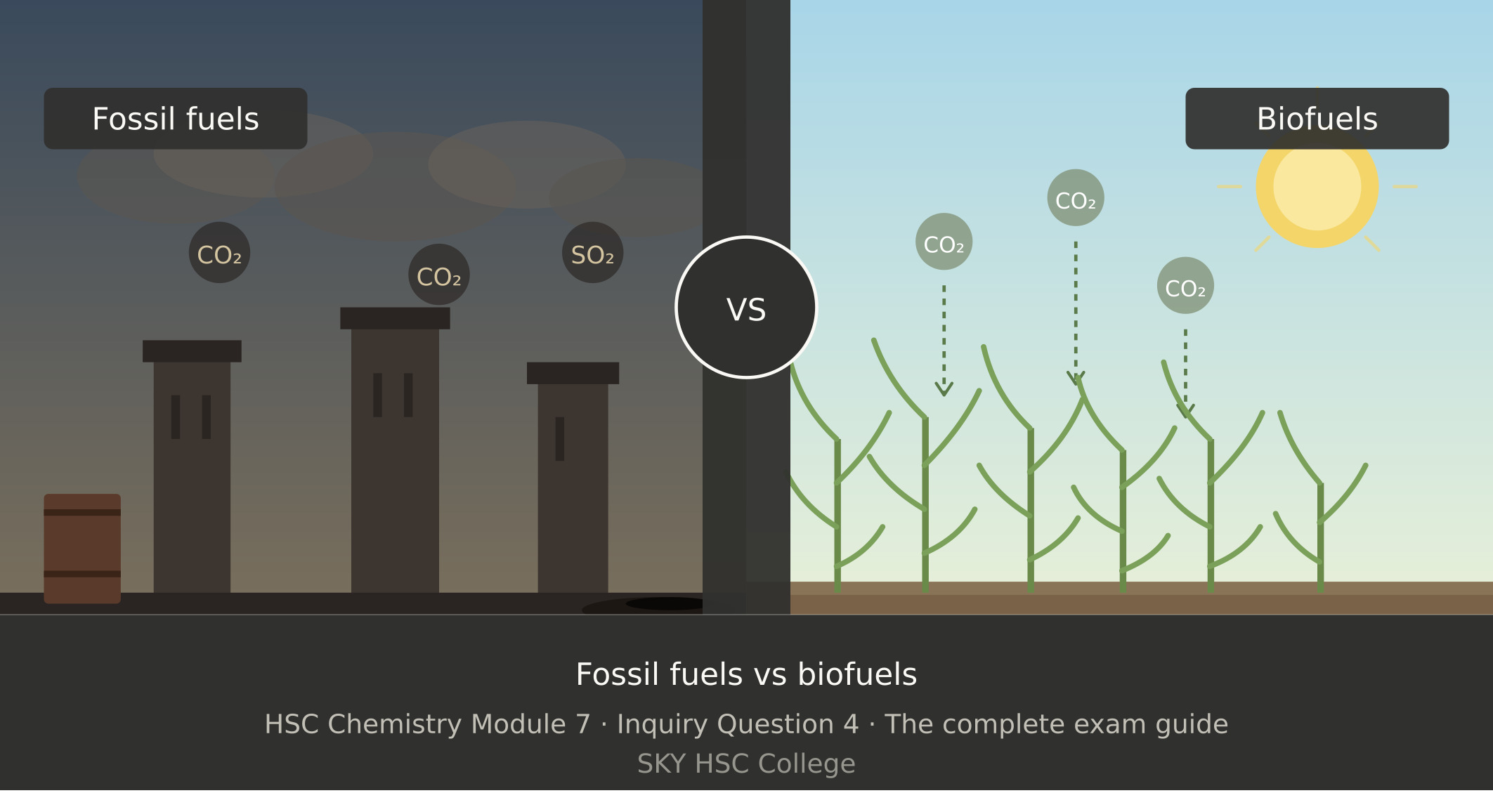
HSC Chemistry Module 7: Fossil Fuels vs Biofuels — Complete Exam Guide
HSC Chemistry Module 7: Fossil Fuels vs Biofuels — Complete Exam Guide | SKY HSC College
Theory · Strategic Framework · Exam Questions · Model Answers · Marking Criteria
April 2026 · Marc · SKY HSC College
NESA Stage 6 Chemistry — Module 7: Organic Chemistry, Inquiry Question 4
"Compare and contrast fuels from organic sources to biofuels, including ethanol."
Every year, students walk into the HSC Chemistry exam confident they know the difference between fossil fuels and biofuels — and every year, a significant number of them lose marks. Why? Because they list random advantages and disadvantages without a strategic framework that ties everything back to the one reason biofuels are even being discussed in the first place: fossil fuels are not sustainable.
This guide is built around that single insight. We've analysed marking criteria from 2019–2025 HSC papers and 40+ trial exams (CSSA, Catholic, Independent, major school trials) to identify exactly which arguments NESA markers reward — and we've ranked them into MAJOR (must use) and MINOR (Band 6 boosters) categories so you know exactly where to spend your time.
How to Use This Guide
| Time | Strategy | What to Read |
|---|---|---|
| 5 min (last-minute cram) | Jump to the cheat sheet | TL;DR + Cheat Sheet (bottom of page) |
| 10 min (the strategic core) | Sustainability framework + 4 pillars | TL;DR + Part 5 (the 4 pillars) |
| 20 min (pre-assessment) | Core theory + key equations + framework | Parts 3, 4, 5 |
| Got an hour? | Read the whole guide | Start to finish — every section builds on the last |
📱 Prefer to study interactively? This guide is also available as a fully interactive web app — with searchable content, zoomable SVG diagrams, an Exam Answer Builder for the 4 pillars, MCQ self-tests, and instant-copy flashcards.
👉 Open the interactive Module 7 IQ4 study tool
Works on phone, tablet, and laptop. No login required.
What's Inside This Guide
| Section | Focus | Exam Weight |
|---|---|---|
| TL;DR | One-sentence core principle + quick comparison | Every question |
| The Strategic Framework | The 2 sustainability criteria → 4 pillars hierarchy — MAJOR vs MINOR arguments | The single most important section |
| Exam Verb Strategy | What markers want for "compare and contrast" vs "assess" | 4–8 mark responses |
| Part 1: Fossil Fuels | Why they are unsustainable (CO₂, SO₂, oil spills, ocean acidification) | MC + short answer |
| Part 2: Biofuels | Definition, types, biomass source | MC + short answer |
| Part 3: Ethanol Deep Dive | Two production methods, carbon cycle, combustion | High frequency — appears in 70%+ of IQ4 questions |
| Part 4: The Big Comparison | Master comparison table + similarities & differences | Extended response (5–8 marks) |
| Part 5: ⭐ The 4 Sustainability Pillars (MAJOR + MINOR) | Structured advantages/disadvantages around sustainability | "Assess" questions (5–6 marks) |
| Part 6: Band 6 Boosters | Cellulosic ethanol, microalgae, LCA, E85, biogas | Differentiates Band 5 → Band 6 |
| Exam Q&A Zone | 10 fully worked questions with mark-by-mark breakdowns | Direct exam prep |
| Cheat Sheet | Equations, MAJOR vs MINOR sentence templates | 60-second pre-exam review |
TL;DR — The Core Principle
Fossil fuels are non-renewable hydrocarbons (C and H only) with high energy density but cause permanent environmental damage. Biofuels are renewable oxygenated organic compounds derived from biomass that — while less energy-dense — are fundamentally more sustainable on the two core criteria that define sustainability: renewability and minimal environmental impact. These two criteria unfold into the 4 sustainability pillars — the resource itself, the climate, air quality, and ecosystems — that structure every argument in this guide. Ethanol is the star of this dot point because it can be produced from both renewable (fermentation) and non-renewable (hydration of ethylene) sources.
Quick Comparison
| Property | Fossil Fuels | Biofuels |
|---|---|---|
| Source | Earth's crust (millions of years) | Biomass (grown in months) |
| Renewability | Non-renewable | Renewable |
| Composition | Hydrocarbons (C, H only) | Oxygenated organics (C, H, O) |
| Energy density | Higher (octane: 47.8 kJ/g) | Lower (ethanol: 29.6 kJ/g) |
| Net CO₂ | High — accumulates permanently | Lower — partially offset by photosynthesis |
| Sulfur content | Contains S → produces SO₂ → acid rain | Negligible S → no SO₂ |
| Spill behaviour | Toxic, non-biodegradable | Less toxic, biodegradable |
Key Ranking — Memorise This Once
Energy density (kJ/g), highest to lowest:
Natural gas (53.6) > Octane/petrol (47.8) > Diesel (42.6) > Biodiesel (37.2) > Propanol (33.6) > Ethanol (29.6) > Methanol (22.7)
⭐ The Strategic Framework — 2 Criteria → 4 Pillars
This is the most important section in the guide. Read it twice.
Sustainability in HSC Chemistry rests on two core criteria:
- Renewability — can the fuel be replenished on human timescales?
- Minimal environmental impact — does the fuel avoid lasting harm to the climate, air, and ecosystems?
Every advantage of biofuels and every disadvantage of fossil fuels can be traced back to one of these two criteria. Together, they unfold into four sustainability pillars that structure every argument in this guide:
- Pillar 1 (Resource) — comes directly from criterion 1 (renewability)
- Pillars 2, 3, 4 (Climate, Air Quality, Ecosystems) — three dimensions of criterion 2 (minimal environmental impact)
The single biggest reason students lose marks on IQ4 is they treat "advantages of biofuels" as a memorised laundry list. Markers don't reward laundry lists — they reward arguments that systematically map back to these two criteria. If your extended response is structured around the 4 pillars, you are mathematically more likely to hit the marking criteria.
The 4 Sustainability Pillars (MAJOR — use these EVERY time)
| Pillar | Criterion | What It Means | Why Fossil Fuels Fail | Why Biofuels Succeed |
|---|---|---|---|---|
| 1. The Resource | Renewability | Will the fuel run out? | Take millions of years to form → finite | Biomass regrows in months via photosynthesis → renewable |
| 2. The Climate | Min env impact | Does combustion add net CO₂? | Releases ancient carbon → permanent net CO₂ increase → enhanced greenhouse effect → ocean acidification | Carbon cycle partially offset by photosynthesis → lower net CO₂ |
| 3. Air Quality | Min env impact | What pollutants besides CO₂? | Incomplete combustion → CO + soot; sulfur impurities → SO₂ → acid rain; particulates → respiratory disease and cancer | O atom in molecule → cleaner combustion; no sulfur → no SO₂; less particulate emission |
| 4. Ecosystems | Min env impact | What happens when fuel enters environment? | Toxic, non-biodegradable → long-term soil and water contamination from spills | Biodegradable, non-toxic → minimal environmental damage from spills |
The MINOR Arguments (Band 6 boosters — use AFTER the 4 pillars)
These are real and valid points, but they are add-ons. Use them only after you've covered the 4 pillars, or your response will look unfocused.
| Minor Argument | When to Use |
|---|---|
| Higher octane rating (~108 vs ~91-98) | Discussion of engine performance |
| Reduces dependence on imported fossil fuels (energy security) | When the question mentions economics or geopolitics |
| Microalgae and 3rd-generation biofuels | Future potential / sustainability extension |
How This Maps to Mark Allocation
| Question size | Strategy |
|---|---|
| 3 marks | Use 1 pillar in depth (with equation + data) |
| 4 marks | Use 2 pillars (e.g., Resource + Climate, OR Air Quality + Ecosystems) |
| 5–6 marks ("assess") | Use 3–4 pillars + balanced disadvantages + judgement |
| 6+ marks ("compare and contrast") | All 4 pillars + similarities + ethanol-specific points + judgement |
The marker's mental checklist: Most NESA markers grade extended responses by mentally ticking off how many distinct sustainability arguments you raise. Each pillar is a tick. Disconnected facts are not.
Exam Verb Strategy — What Markers Actually Want
| NESA Verb | What markers want | Similarities needed? | Judgement needed? |
|---|---|---|---|
| Compare and contrast | Identify BOTH similarities AND differences using specific data | Yes — this is where most students lose marks | No |
| Assess | Advantages + disadvantages + your judgement with supporting data | Not required but strengthens response | Yes — must include |
| Explain | Cause → effect chain with chemical reasoning | Only if relevant | No |
| Discuss | Present multiple viewpoints/aspects with evidence | Helpful | Recommended |
#1 reason students lose marks on IQ4: They write a list of differences only and forget that "compare" means you must also discuss similarities — e.g., both fossil fuels and biofuels undergo combustion to release energy, both produce CO₂ and H₂O as products, both are used as transport fuels.
Sentence Template Scaffold
Use this structure for any comparison point — and always anchor it to a sustainability pillar:
"Both [fossil fuels] and [biofuels] [SIMILARITY], however [fossil fuels] [DIFFERENCE 1] while [biofuels] [DIFFERENCE 2]. This makes biofuels more sustainable in terms of [PILLAR]. For example, [SPECIFIC DATA]."
Example:
"Both fossil fuels and biofuels undergo complete combustion to produce CO₂ and H₂O, however octane requires 12.5 mol O₂ per mole (from 2C₈H₁₈ + 25O₂) while ethanol requires only 3 mol O₂ per mole, as ethanol already contains an oxygen atom in its molecular structure. This means ethanol is more likely to undergo complete combustion, producing significantly less toxic CO and soot — supporting the air-quality sustainability of biofuels."
Part 1: What Are Fossil Fuels? (And Why They Aren't Sustainable)
"Compare and contrast fuels from organic sources to biofuels, including ethanol."
Think about this: Every time you fill up a car with petrol, you're burning the remains of organisms that died hundreds of millions of years ago. That tank of fuel took nature ~300 million years to produce — and you'll burn through it in a week. That's the fundamental problem with fossil fuels, and it's the reason this entire dot point exists in the syllabus.
1.1 Definition and Formation
A fossil fuel is a fuel formed from the anaerobic decomposition of dead organisms over millions of years under heat and pressure deep within the Earth's crust. Because they form on geological timescales (10⁶–10⁸ years), they are classified as non-renewable — we consume them far faster than they can be replaced. This is the failure of Pillar 1 (The Resource).
1.2 Types of Fossil Fuels
| Fuel | Main Component | Formula | State | Energy (kJ/g) |
|---|---|---|---|---|
| Natural gas | Methane | CH₄ | Gas | 53.6 |
| LPG | Propane/Butane | C₃H₈ / C₄H₁₀ | Liquefied gas | ~49.5 |
| Petrol | Octane (representative) | C₈H₁₈ | Liquid | 47.8 |
| Diesel | Long-chain alkanes | ~C₁₂H₂₆ | Liquid | 42.6 |
| Coal (lignite → anthracite) | Complex C structures | Variable | Solid | ~10–33 |
Carbon Chain Length Determines Physical State
Fossil fuels span the C₁ to C₄₀ hydrocarbon range, and the physical state correlates directly with chain length — a connection markers reward:
| Chain length | State | Examples |
|---|---|---|
| Short (C₁–C₄) | Gas | Methane (CH₄), propane (C₃H₈), butane (C₄H₁₀) |
| Medium (C₅–C₁₆) | Liquid | Petrol (~C₈H₁₈), kerosene (~C₁₂H₂₆), diesel |
| Long (C₂₀+) | Solid / waxy | Heavy fuel oils, asphaltenes, paraffin waxes |
| Complex C network | Solid | Coal (lignite → bituminous → anthracite) |
Why chain length controls state: longer chains have more electrons → stronger dispersion (London) forces between molecules → higher boiling points → more likely to be liquid or solid at room temperature. This is a direct link back to Module 1 (intermolecular forces) that examiners love.
1.3 Chemical Composition — The Key Detail
All fossil fuels are hydrocarbons — molecules made of carbon and hydrogen only. This is a critical exam point: because they contain no oxygen in their molecular structure, they require a large supply of external O₂ for complete combustion.
Complete combustion of octane:
2C₈H₁₈(l) + 25O₂(g) → 16CO₂(g) + 18H₂O(l) — ΔHc = −5470 kJ/mol
Note: Each mole of octane requires 12.5 mol O₂ (from 25/2). This massive oxygen demand means incomplete combustion is common in conventional engines, producing toxic carbon monoxide (CO) and soot (C).
1.4 Why Fossil Fuels Are Not Sustainable — The Four Failures
This sub-section is critical because it sets up the entire 4-pillar framework. Every disadvantage of fossil fuels maps to a pillar.
Failure of Pillar 2 (Climate) — Permanent CO₂ Increase + Ocean Acidification
Combustion of fossil fuels releases CO₂ that was sequestered underground for millions of years. This CO₂ is additional to the modern carbon cycle — it cannot be reabsorbed quickly. The result is a permanent net increase in atmospheric CO₂, driving the enhanced greenhouse effect.
But the consequence doesn't stop in the atmosphere. CO₂ also dissolves in oceans and reacts with water to form carbonic acid:
CO₂(g) ⇌ CO₂(aq)
CO₂(aq) + H₂O(l) ⇌ H₂CO₃(aq)
This lowers the pH of oceans — ocean acidification — which threatens marine organisms (especially calcifying species like corals and shellfish, whose CaCO₃ shells dissolve at lower pH). This is a direct connection to Module 5/6 (equilibrium and acid chemistry) that markers love to see referenced.
⚠️ Terminology — "Climate change" is preferred over "global warming"
NESA marking guidelines and the broader scientific community both prefer climate change over global warming. The reason:
- Global warming refers only to one effect — rising average temperatures.
- Climate change is the umbrella term covering ALL effects of the enhanced greenhouse effect: temperature rise, sea-level rise, extreme weather, ocean acidification, glacial melt, and ecosystem disruption.
In an HSC exam, always write "climate change". It demonstrates more sophisticated scientific literacy and aligns with NESA's preferred terminology.
Failure of Pillar 3 (Air Quality) — Multiple Pollutants
Fossil fuel combustion in conventional engines produces several harmful emissions beyond CO₂:
- Carbon monoxide (CO) and soot (C) from incomplete combustion when oxygen supply is limited
- Sulfur dioxide (SO₂) from sulfur impurities in coal, diesel, and crude petroleum products. SO₂ reacts with atmospheric water to form sulfurous and sulfuric acids → acid rain, which damages forests, lakes, and infrastructure
- Particulate matter (PM) — microscopic carbon and ash particles. Long-term exposure to particulate emissions is associated with respiratory disease, cardiovascular disease, and lung cancer, imposing significant healthcare costs on communities
The 3 Combustion Products — Health Impact Triad
A common Pillar 3 trap is mixing up the toxicity profiles of the three combustion products. Memorise this distinction:
| Product | Conditions | Toxicity / Health Impact | IARC classification |
|---|---|---|---|
| CO₂ (carbon dioxide) | Complete combustion (sufficient O₂) | Greenhouse gas → climate change + ocean acidification. Not directly toxic at normal concentrations. | Not classified |
| CO (carbon monoxide) | Incomplete combustion (limited O₂) | Toxic — binds to haemoglobin ~250× more strongly than O₂ → asphyxiation; respiratory and cardiovascular distress. NOT classified as carcinogenic (IARC Group 3). | Group 3 (not classifiable) |
| Soot (elemental C particulates) | Severe incomplete combustion | Carcinogenic — fine particulate matter penetrates deep into lungs → lung cancer; cardiovascular disease | Group 1 (carcinogenic to humans) |
Exam-safe wording: "CO is toxic but is not classified as a carcinogen. Soot — the fine particulate carbon produced by severe incomplete combustion — is the carcinogenic species, classified as IARC Group 1."
Failure of Pillar 4 (Ecosystems) — Toxic, Non-biodegradable Spills
Crude oil and petroleum products are toxic to marine and terrestrial life and not biodegradable. Major oil spills (Exxon Valdez, Deepwater Horizon) cause decades of ecosystem damage because hydrocarbons persist in soil and water for years.
Self-Check: Can you write the balanced equation for complete combustion of methane with state symbols? Check your answer in the Cheat Sheet (Equation #6) at the end of this guide.
Part 2: What Are Biofuels?
"Compare and contrast fuels from organic sources to biofuels, including ethanol."
Think about this: What if instead of digging up ancient carbon, we could grow our fuel in a field and harvest it every season? That's the promise of biofuels — and it directly addresses every one of the four sustainability failures of fossil fuels.
2.1 Definition
A biofuel is a fuel derived from biomass — biological material from living or recently living organisms. Because the source organisms can be regrown in months to years, biofuels are classified as renewable.
2.2 Types of Biofuels
| Biofuel | Source | Production Method | Formula |
|---|---|---|---|
| Bioethanol | Sugar cane, corn, wheat | Fermentation of glucose | C₂H₅OH |
| Biodiesel | Vegetable oils, animal fats | Transesterification with methanol | Long-chain esters (e.g., C₁₉H₃₆O₂) |
| Biogas | Organic waste, manure | Anaerobic digestion | CH₄ (+ CO₂) |
2.3 Chemical Composition — The Key Difference
Unlike fossil fuels (C and H only), biofuels are oxygenated organic compounds — they contain oxygen in their molecular structure. This single difference drives several exam-relevant consequences:
- Less O₂ needed for complete combustion → cleaner burning (Pillar 3)
- Lower energy density per gram (the C–O bond stores less energy than C–H or C–C bonds) — this is the main trade-off
- No sulfur impurities → no SO₂ emissions → no acid rain (Pillar 3)
- Biodegradable → less environmental damage from spills (Pillar 4)
Self-Check: Why does the presence of oxygen in ethanol's structure lead to cleaner combustion? Check in the Exam Q&A Zone (Question 5) below.
Part 3: Ethanol — The Star of IQ4
"Compare and contrast fuels from organic sources to biofuels, including ethanol."
Think about this: The syllabus dot point specifically names ethanol. Why? Because ethanol is the only common fuel that can be produced from both renewable AND non-renewable sources — making it the perfect molecule for a "compare and contrast" question. If you only write about one production method, you're leaving marks on the table.
3.1 Two Ways to Produce Ethanol
This is one of the most frequently tested concepts in IQ4. Ethanol bridges the fossil fuel / biofuel divide because it can be made two completely different ways:
| Feature | Fermentation (Renewable) | Hydration of Ethylene (Non-renewable) |
|---|---|---|
| Source | Biomass — sugar cane, corn, wheat | Petroleum — ethylene from cracking |
| Feedstock | Glucose (C₆H₁₂O₆) | Ethylene (CH₂=CH₂) |
| Catalyst | Yeast (biological enzyme) | H₃PO₄ (phosphoric acid) |
| Conditions | 30–35°C, anaerobic, dilute solution | 300°C, 70 atm, high pressure |
| Rate | Slow (batch process, days) | Fast (continuous process) |
| Yield | Low (~15% ethanol before yeast dies) | High (>95% conversion) |
| Purity | Low — requires distillation | High — relatively pure product |
| Renewability | Renewable | Non-renewable |
| Scale | Labour-intensive | Few workers, automated |
Fermentation equation:
C₆H₁₂O₆(aq) → 2C₂H₅OH(l) + 2CO₂(g)
Conditions: yeast, 30–35°C, anaerobic
Hydration of ethylene equation:
CH₂=CH₂(g) + H₂O(g) → C₂H₅OH(l)
Conditions: H₃PO₄ catalyst, 300°C, 70 atm
HSC MC Trap: "Which compound can be derived both from fossil fuels and from biomass materials?" Answer: Ethanol. This question (inspired by Fort Street 2019 Q15) catches students who only associate ethanol with fermentation.
3.2 The Full Bioethanol Production Process — Why It's So Difficult
Understanding the full production chain is critical for explaining why bioethanol is commercially and economically limited. The feedstock matters: not all carbohydrate sources are equal.
Three feedstock categories — easiest to hardest:
| Feedstock Type | Example Sources | Production Difficulty |
|---|---|---|
| Sucrose-based | Sugarcane, fruits | Easiest — sucrose readily hydrolysed by yeast enzymes |
| Starch-based | Wheat, corn, grains | Moderate — starch must first be broken down to glucose |
| Cellulose-based | Wood residues, agricultural waste, switchgrass | Hardest — cellulose has a tightly packed structure that yeast enzymes cannot break down, requiring acid hydrolysis or specialised enzymes |
This hierarchy matters because the food-vs-fuel debate hinges on it. Sucrose and starch feedstocks are food crops; cellulose feedstocks are agricultural waste. The push for 2nd-generation cellulosic ethanol is the chemistry community's attempt to escape the food-vs-fuel dilemma — but cellulose is hard to break down, which is why most commercial bioethanol still relies on food crops.
3.2.1 Why Plants Can Be Used as Fuel — The Cellulose Connection
Before diving into the production process, it's worth understanding the molecular basis for why ANY plant can theoretically be used to produce bioethanol. The chain of reasoning is exam-essential:
The 5-step logical chain:
- Every plant is made of cells
- Every plant cell has a cell wall
- Every cell wall contains cellulose
- Cellulose is a polymer of glucose — many C₆H₁₂O₆ units joined together (a polysaccharide)
- Therefore, any plant can theoretically produce ethanol if we can break cellulose down into glucose, then ferment glucose to ethanol
This is why bioethanol is universally referred to as a "biomass-derived" fuel. The differences between feedstocks (sugarcane, corn, wood, switchgrass, microalgae) come down to how easily we can extract glucose from each source — not whether glucose is present at all.
"Plant cell walls contain cellulose — multiple glucose units joined together. All plants contain cellulose, making them potential sources for bioethanol production. Sugarcane is the primary first-generation example because its sucrose hydrolyses easily to glucose."
Why this matters for exam answers: This single chain explains why all 1st-, 2nd-, AND 3rd-generation biofuels share the same fundamental chemistry — they all reduce to "extract glucose, ferment to ethanol." The differences are just how easy it is to GET to the glucose. This is also a powerful Module 1 ↔ Module 7 cross-link that markers reward (carbohydrates as polymers connecting to biofuel chemistry).
Step 1 — Hydrolysis (Carbohydrate → Glucose)
For sucrose- and starch-based feedstocks, yeast enzymes can perform the hydrolysis directly. Cellulose is different — its structure is too tightly packed for yeast enzymes to break down, requiring either acid hydrolysis or specialised cellulase enzymes that are expensive to produce at industrial scale.
Step 2 — Fermentation (Glucose → Aqueous Ethanol)
Once glucose is obtained, yeast converts it to ethanol and CO₂:
C₆H₁₂O₆(aq) → 2C₂H₅OH(l) + 2CO₂(g) — yeast, 30–35°C, anaerobic
The problem: yeast controls this reaction, not humans. Fermentation is a batch process that takes days, produces only a dilute aqueous ethanol solution (~15% before the yeast dies from alcohol toxicity), and is inherently slow.
Step 3 — Fractional Distillation (Aqueous Ethanol → Pure Ethanol)
The dilute aqueous ethanol from fermentation must be purified into fuel-grade ethanol. This requires fractional distillation — a process that demands substantial energy input (heating the mixture repeatedly to separate ethanol from water based on boiling point differences). The energy used in distillation is one of the largest contributors to bioethanol's overall production cost and reduces its net energy yield significantly.
Why this matters for exam answers: The inefficiency of the hydrolysis-fermentation steps means bioethanol cannot currently be mass produced at the scale needed to fully replace fossil fuels → commercially limited. The substantial energy cost of distillation means production is expensive → economically constrained. These are the two core reasons why bioethanol has not replaced fossil fuels despite its environmental advantages.
3.3 The Ethanol Carbon Cycle — Theoretically Neutral, Practically NOT
This is the most important concept for this dot point, and the one where students most commonly lose marks by oversimplifying. Three reactions form a theoretical cycle:
Step 1 — Photosynthesis (6 CO₂ ABSORBED):
6CO₂(g) + 6H₂O(l) → C₆H₁₂O₆(aq) + 6O₂(g)
Step 2 — Fermentation (2 CO₂ RELEASED):
C₆H₁₂O₆(aq) → 2C₂H₅OH(l) + 2CO₂(g)
Step 3 — Combustion of Ethanol (4 CO₂ RELEASED):
2C₂H₅OH(l) + 6O₂(g) → 4CO₂(g) + 6H₂O(l)
The maths:
- CO₂ absorbed: 6 mol (photosynthesis)
- CO₂ released: 2 mol (fermentation) + 4 mol (combustion) = 6 mol
- Net CO₂ = 0 → Theoretically carbon neutral
CRITICAL — Do NOT stop here. Many students (and some textbooks) conclude that ethanol is "carbon neutral." This is incorrect in practice.
⚠️ Terminology — Carbon Neutral ≠ Greenhouse Neutral
These two terms are often confused. They mean different things, and using them precisely is a Band 6 distinguisher:
| Term | Definition | Applies to bioethanol? |
|---|---|---|
| Carbon neutral | Net CO₂ released = net CO₂ absorbed (only counts CO₂) | The 3-equation cycle is theoretically carbon neutral. In practice, fossil-fuel use during production breaks this — bioethanol is NOT truly carbon neutral. |
| Greenhouse neutral | Net all greenhouse gases (CO₂, CH₄, N₂O, etc.) = zero | Bioethanol is NOT greenhouse neutral — fertilisers release N₂O (a greenhouse gas ~300× more potent than CO₂), distillation releases CO₂, and transport releases CO₂. This is a stricter standard than carbon neutrality. |
Use the correct term in exams. "Carbon neutral" specifically refers to CO₂ balance only. "Greenhouse neutral" demands all greenhouse gases balance — a stricter test bioethanol fails by an even wider margin. Saying bioethanol is "greenhouse neutral" is more wrong than saying it is "carbon neutral".
Why Ethanol is NOT Truly Carbon Neutral
While the three-equation carbon cycle balances perfectly on paper (6 CO₂ in = 6 CO₂ out), the production process requires additional energy that typically comes from fossil fuels:
- Cultivation — tractors, irrigation pumps (diesel/electricity)
- Harvesting — machinery powered by fossil fuels
- Fertiliser production — energy-intensive Haber process
- Distillation — separating ethanol from water requires significant heating
- Transportation — trucks, ships moving raw materials and product
This additional fossil fuel use adds CO₂ to the cycle that is not offset by photosynthesis. Independent life-cycle studies estimate that bioethanol's net greenhouse gas emissions are typically around 10–30% lower than petrol — a meaningful improvement, but far from zero, and the figure varies considerably depending on the feedstock and the energy mix used in production. (For comparison, biodiesel typically achieves a larger reduction of ~40% versus conventional diesel.)
The exam-safe statement: "While the ethanol carbon cycle is theoretically balanced (6 mol CO₂ absorbed = 6 mol CO₂ released), bioethanol is NOT truly carbon neutral because the production process — including cultivation, harvesting, fertiliser production, distillation, and transportation — requires energy from fossil fuels, adding CO₂ that is not offset by photosynthesis. Nevertheless, life-cycle analyses suggest net emissions are typically 10–30% lower than those of petrol."
3.4 Combustion — Ethanol vs Octane
Both ethanol and octane undergo complete combustion to produce CO₂ and H₂O (this is a similarity — don't forget it!). But there are critical quantitative differences:
Ethanol combustion:
C₂H₅OH(l) + 3O₂(g) → 2CO₂(g) + 3H₂O(l) — ΔHc = −1367 kJ/mol
Octane combustion:
2C₈H₁₈(l) + 25O₂(g) → 16CO₂(g) + 18H₂O(l) — ΔHc = −5470 kJ/mol
| Property | Ethanol | Octane (Petrol) |
|---|---|---|
| Formula | C₂H₅OH | C₈H₁₈ |
| Molar mass | 46.07 g/mol | 114.23 g/mol |
| ΔHc | −1367 kJ/mol | −5470 kJ/mol |
| Energy density | 29.6 kJ/g | 47.8 kJ/g |
| O₂ required per mol | 3 mol | 12.5 mol (from 25/2) |
| Contains O atom? | Yes | No |
| Combustion cleanliness | Cleaner — less CO, less soot | Dirtier — more incomplete combustion |
Why Ethanol Burns More Cleanly
This is a favourite short-answer question. The mechanism is straightforward:
- Ethanol (C₂H₅OH) already contains an oxygen atom in its molecular structure
- Therefore it requires less external O₂ for complete combustion (3 mol vs 12.5 mol per mol)
- In a car engine where air supply is limited, ethanol is more likely to achieve complete combustion
- Octane's massive O₂ demand (12.5 mol) means it frequently undergoes incomplete combustion, producing toxic CO and particulate soot (C)
Exam-ready sentence: "Ethanol burns more cleanly than octane because it contains an oxygen atom in its molecular structure (C₂H₅OH), requiring only 3 mol O₂ for complete combustion compared to 12.5 mol O₂ per mole of octane. This lower oxygen demand means ethanol is less likely to undergo incomplete combustion, producing significantly less toxic carbon monoxide and soot."
Part 4: The Big Comparison — Fossil Fuels vs Biofuels
"Compare and contrast fuels from organic sources to biofuels, including ethanol."
Think about this: If you're writing an extended response, this table is your blueprint. Every row is a potential mark. A 6-mark "compare and contrast" question typically needs 3 similarities + 3 differences, each supported by specific data.
Master Comparison Table
| Property | Fossil Fuels | Biofuels (Bioethanol) |
|---|---|---|
| Chemical composition | Hydrocarbons (C & H only) — e.g., C₈H₁₈, CH₄ | Oxygenated organic compounds — e.g., C₂H₅OH (contains O) |
| Source | Mining/drilling from Earth's crust (formed over millions of years) | Agricultural crops — sugar cane, corn (grown in months) |
| Renewability (Pillar 1) | Non-renewable — will be depleted | Renewable — biomass regrows via photosynthesis |
| Energy content (kJ/g) | Petrol: 47.8, Natural gas: 53.6, Coal: ~10–33 | Bioethanol: 29.6 (~38% less than petrol), Biodiesel: 37.2 (~13% less than diesel) |
| CO₂ emissions (Pillar 2) | High net release — CO₂ accumulates permanently; drives ocean acidification | Lower net release — partially offset by photosynthesis (10–30% less) |
| Sulfur emissions (Pillar 3) | Coal/diesel contain sulfur impurities → SO₂ → acid rain | Negligible sulfur → no SO₂ → no acid-rain contribution |
| Particulate emissions (Pillar 3) | Significant — linked to lung disease, cardiovascular disease, cancer | Significantly lower particulate emissions |
| Combustion quality | Needs more O₂ → prone to incomplete combustion (CO, soot) | Contains O atom → cleaner combustion, less CO and soot |
| NOₓ emissions (Pillar 3 — counterpoint) | Variable | Can produce slightly higher NOₓ in some engines (acid rain contributor) |
| Biodegradability (Pillar 4) | Non-biodegradable; toxic; oil spills cause decades of damage | Biodegradable and non-toxic; spills cause minimal long-term damage |
| Vehicle compatibility | No modification required | E10: no modification, E85+: engine modification required |
| Cost / availability | Established infrastructure but finite supply, volatile pricing | Supplementary only (~10% of fuel mix), dependent on subsidies |
| Environmental issues | Climate change, acid rain, ocean acidification, oil-spill contamination | Land use, food vs fuel, water usage, biodiversity loss |
4.1 Similarities — Don't Forget These!
This is where most students lose marks. When the question says "compare and contrast," you must include similarities:
- Both undergo combustion to release energy as heat — both are exothermic fuels used to power vehicles and generate electricity
- Both produce CO₂ and H₂O as complete combustion products — the fundamental reaction type is the same
- Both are used as transport fuels — petrol/diesel for conventional vehicles, bioethanol blended as E10 (10% ethanol, 90% petrol) in standard engines
- Both are carbon-based organic compounds — they are molecular substances containing carbon
- Both can undergo incomplete combustion when oxygen supply is limited, producing CO and soot (though biofuels are less prone to this)
4.2 Key Differences
| Aspect | Fossil Fuels | Biofuels |
|---|---|---|
| Renewability | Non-renewable (finite supply) | Renewable (biomass regrows) |
| Time to form | Millions of years | Months (crop cycle) |
| Molecular oxygen | No O in structure | Contains O (e.g., C₂H₅OH) |
| Energy per gram | Higher (47.8 kJ/g for octane) | Lower (29.6 kJ/g for ethanol — ~38% less) |
| Net CO₂ impact | All released CO₂ is "new" to atmosphere | Partially offset by photosynthesis during crop growth |
| O₂ demand | Higher (12.5 mol O₂/mol octane) | Lower (3 mol O₂/mol ethanol) |
| Sulfur impurities | Present in coal/diesel | Negligible |
| Biodegradability | Non-biodegradable | Biodegradable |
| Production source | Geological extraction | Agricultural cultivation |
Part 5: ⭐ The 4 Sustainability Pillars — Advantages, Disadvantages & Strategy
This section replaces the old "advantages and disadvantages list." Use this exact structure in your extended responses.
For any question using the verb "assess" — and for every "compare and contrast" question — structure your answer around the four sustainability pillars. Within each pillar, present biofuel's advantage AND any associated disadvantage. Then deliver a judgement.
The pillars below are ordered by exam frequency. MAJOR pillars are non-negotiable; MINOR points are extension material.
🟢 PILLAR 1 (MAJOR) — Sustainability of the Resource: Renewability
This is the foundational argument. It is the single most-cited reason biofuels are being developed at all.
Biofuels are derived from biomass — sugar cane, corn, organic waste — which can be regrown within months via photosynthesis. Fossil fuels, in contrast, take millions of years to form and are being consumed faster than they can ever be replaced. This is the failure that motivates the entire dot point.
Photosynthesis (the renewability equation): 6CO₂(g) + 6H₂O(l) → C₆H₁₂O₆(aq) + 6O₂(g)
"Bioethanol is a renewable fuel because its source — glucose obtained from biomass such as sugar cane — is continuously replenished through photosynthesis. Unlike fossil fuels, which are finite and being depleted, biofuel feedstocks are sustainable over human timescales."
Associated disadvantage — lower energy density (the trade-off):
The renewable nature of biofuels comes with an energy cost. The C–O bond present in oxygenated biofuels stores less energy than the C–H and C–C bonds of pure hydrocarbons. Ethanol delivers 29.6 kJ/g vs octane's 47.8 kJ/g — approximately 38% less energy per gram. Vehicles need more biofuel by mass to travel the same distance.
"Although bioethanol is renewable, its energy density (29.6 kJ/g) is approximately 38% lower than that of octane (47.8 kJ/g), meaning fuel consumption per kilometre is correspondingly higher."
🟢 PILLAR 2 (MAJOR) — Sustainability of the Climate: Lower Net CO₂ + Ocean Health
The carbon cycle of bioethanol partially offsets combustion emissions because the CO₂ released was originally absorbed during photosynthesis.
The three-equation cycle:
Step 1 — Photosynthesis: 6CO₂(g) + 6H₂O(l) → C₆H₁₂O₆(aq) + 6O₂(g) — 6 CO₂ absorbed
Step 2 — Fermentation: C₆H₁₂O₆(aq) → 2C₂H₅OH(l) + 2CO₂(g) — 2 CO₂ released
Step 3 — Combustion: 2C₂H₅OH(l) + 6O₂(g) → 4CO₂(g) + 6H₂O(l) — 4 CO₂ released
Total CO₂ absorbed = 6 mol, Total CO₂ released = 2 + 4 = 6 mol → theoretically balanced.
Climate consequence of fossil fuel combustion — ocean acidification:
The CO₂ released by burning fossil fuels doesn't just stay in the atmosphere. It dissolves in oceans:
CO₂(g) ⇌ CO₂(aq)
CO₂(aq) + H₂O(l) ⇌ H₂CO₃(aq)
Carbonic acid lowers ocean pH — ocean acidification — threatening calcifying organisms (corals, shellfish, plankton) whose CaCO₃ structures dissolve at lower pH. This is a powerful Module 5/6 cross-link that markers reward.
"Combustion of bioethanol releases CO₂ that was originally absorbed from the atmosphere during photosynthesis of the source crop. Although life-cycle analyses show that production-related fossil fuel use prevents true carbon neutrality, the net greenhouse-gas reduction (typically 10–30%) lessens the contribution to climate change AND to ocean acidification, both of which are caused by the permanent net CO₂ release from fossil fuel combustion."
Associated disadvantage — production emissions:
The 10–30% net reduction figure is not zero because cultivation, fertilisers, distillation, and transport currently rely on fossil fuels. This is why bioethanol is NOT truly carbon neutral despite the balanced equations.
🟢 PILLAR 3 (MAJOR) — Sustainability of Air Quality: Cleaner Combustion
This is the pillar with the most chemistry inside it — and therefore the highest-yielding for marks. Three distinct improvements sit under this pillar.
(a) Less CO and soot — the molecular oxygen advantage
Ethanol contains an oxygen atom (C₂H₅OH), reducing the amount of external O₂ needed for complete combustion:
Ethanol: C₂H₅OH(l) + 3O₂(g) → 2CO₂(g) + 3H₂O(l) — only 3 mol O₂ per mol
Octane: 2C₈H₁₈(l) + 25O₂(g) → 16CO₂(g) + 18H₂O(l) — 12.5 mol O₂ per mol
Because ethanol already contains O in its structure, it needs far less external oxygen. In a car engine where air supply is limited, ethanol is more likely to achieve complete combustion, producing significantly less toxic carbon monoxide (CO) and particulate soot (C).
(b) No sulfur impurities → no SO₂ → no acid rain
Fossil fuels — especially coal and crude petroleum products — contain sulfur impurities that, on combustion, form sulfur dioxide (SO₂):
S(in fuel) + O₂(g) → SO₂(g)
SO₂ in the atmosphere reacts with water vapour to produce sulfurous and sulfuric acids, which fall as acid rain, damaging forests, acidifying lakes, and eroding limestone buildings and infrastructure. Bioethanol contains negligible sulfur, so it does not contribute to acid rain.
"Bioethanol contains no sulfur impurities, eliminating SO₂ emissions and the resulting acid rain that occurs from the combustion of sulfur-bearing fossil fuels."
(c) Less particulate matter → lower respiratory disease and cancer risk
Particulate matter (microscopic carbon and ash particles) from incomplete fossil-fuel combustion is associated with respiratory disease, cardiovascular disease, and lung cancer — note: it is the soot particulates that are carcinogenic (IARC Group 1), not CO itself. Reducing particulate emissions translates directly into reduced healthcare costs and improved public health. Bioethanol's complete-combustion advantage means it produces significantly less particulate matter.
"The cleaner combustion of bioethanol reduces particulate emissions, lowering the incidence of respiratory disease and lung cancer associated with prolonged exposure to fine particulate matter from petrol and diesel exhaust."
Associated disadvantage — slightly higher NOₓ emissions in some engines:
Be balanced: bioethanol and biodiesel can produce slightly higher nitrogen oxide (NOₓ) emissions than fossil fuels in some engine configurations, because biofuels combust at higher in-cylinder temperatures. NOₓ also contributes to acid rain and smog. Mentioning this nuance in an "assess" question demonstrates Band 6 critical analysis.
"While bioethanol significantly reduces SO₂ and particulate emissions, some engine configurations produce slightly higher NOₓ emissions when running on biofuel blends, partially offsetting the air-quality benefit."
🟢 PILLAR 4 (MAJOR) — Sustainability of Ecosystems: Biodegradability and Non-toxicity
This pillar is almost universally underused by students — which is exactly why it differentiates a good response from a great one.
Bioethanol and biodiesel are both biodegradable and non-toxic. In contrast, petroleum-based fuels are persistent organic pollutants that are toxic to aquatic and terrestrial life. The consequences become dramatic when fuel enters the environment via spills:
- A petrol or diesel spill contaminates soil and water for years to decades (e.g., Exxon Valdez 1989 — beaches still showed contamination 20+ years later)
- A bioethanol spill is broken down by microorganisms within weeks to months and causes minimal long-term ecological damage
"Bioethanol is biodegradable and non-toxic, meaning fuel spills cause significantly less long-term environmental damage than spills of non-biodegradable petroleum products, which can contaminate soil and water bodies for decades."
Associated disadvantage — large-scale agriculture causes ecosystem damage:
The production-side disadvantage is real: large-scale biofuel cultivation requires vast areas of arable land. Clearing forests and grasslands for biofuel crops causes:
- Soil erosion and land degradation from intensive farming
- Deforestation and loss of natural habitats
- Loss of biodiversity — large-scale monoculture reduces species diversity dramatically
- Paradoxically, clearing forests releases stored carbon, potentially increasing net CO₂ emissions
"While bioethanol is itself biodegradable, large-scale biofuel cultivation requires substantial land conversion, contributing to deforestation, soil erosion, and significant loss of biodiversity through monoculture farming."
🔵 MINOR Advantage (Band 6 booster) — Higher Octane Rating
Ethanol has a higher octane rating (~108) than regular petrol (~91–98), which reduces engine knock and improves combustion efficiency in high-performance engines. This is a real engineering advantage but does NOT map to a sustainability pillar — use it only if you've already covered the four pillars.
🔵 MINOR Advantage (Band 6 booster) — Reduces Fossil-Fuel Dependence (Energy Security)
Using biofuels as a petrol supplement reduces reliance on imported fossil fuels, improving national energy security and reducing exposure to volatile oil prices. This is more an economic/political point than a chemistry point — useful only when the question explicitly invites discussion of broader implications.
🟢 MAJOR Disadvantages (Beyond the Trade-offs Within Each Pillar)
Some disadvantages are major standalone points that don't sit naturally inside a pillar:
MAJOR DIS — Food vs Fuel
Crops used for first-generation bioethanol (sugar cane, corn, wheat) compete directly with food production. Large-scale diversion of arable land to biofuel crops has been linked to rising food prices and food shortages in developing countries. This is the most-cited social/ethical disadvantage of biofuels.
MAJOR DIS — Commercially Limited Production
The hydrolysis-fermentation steps are biologically slow. Sucrose and starch ferment easily with yeast; cellulose is the hardest because its tightly packed structure resists yeast enzymes and requires expensive acid hydrolysis or specialised enzymes. Combined with yeast's ~15% ethanol concentration limit (yeast dies above this due to ethanol toxicity), bioethanol cannot currently be mass produced at the scale needed to fully replace fossil fuels.
MAJOR DIS — Economically Constrained Production
Fractional distillation of dilute aqueous ethanol into pure fuel-grade ethanol requires substantial energy input, significantly reducing the net energy yield and adding cost. Combined with the slow fermentation step, bioethanol production cost remains higher per unit energy than petrol refining.
🔵 MINOR Disadvantages
MINOR DIS — Engine Modification for High Blends + Ethanol's Hygroscopic Nature
Ethanol is hygroscopic — it has a strong affinity for water due to its polar hydroxyl group. This causes two problems:
- It is difficult to obtain and maintain 100% pure ethanol; absorbed water can damage engines
- Ethanol is corrosive to certain rubber and metal components of conventional fuel systems (seals, fuel lines, injectors)
E10 (10% ethanol, 90% petrol) requires no modification, but blends above ~20% ethanol (E20, E85) require engine and fuel system modifications.
"Ethanol's hygroscopic nature — caused by its polar hydroxyl group — means it readily absorbs water, complicating its storage and making blends above E20 incompatible with standard petrol engines without significant modification."
Critical Analysis — The Carbon Cycle is NOT Carbon Neutral
This point doesn't fit neatly into "advantage" or "disadvantage" — it's the nuanced analysis that markers specifically reward and that almost no other resources teach correctly.
The three-equation carbon cycle (photosynthesis → fermentation → combustion) balances to net zero CO₂ on paper. However, the production chain (cultivation, harvesting, fertiliser manufacture, distillation, transportation) requires energy that currently comes from fossil fuels. This adds CO₂ that is not offset by photosynthesis.
Conclusion: Bioethanol is NOT truly carbon neutral, and is even further from being greenhouse neutral. Life-cycle analyses estimate net emissions are typically 10–30% lower than petrol — a meaningful improvement, but far from zero.
Current Reality vs Future Potential — How to Frame Your Exam Answer
This is a critical exam strategy point. How you assess bioethanol depends entirely on the timeframe the question implies:
If the question asks about current viability → focus on disadvantages:
Right now, bioethanol's limitations significantly constrain its role. It cannot be mass produced at the necessary scale, production costs remain higher than petrol, and it has 38% less energy per gram. This is why bioethanol is currently used only as a supplement (E10 — 10% ethanol, 90% petrol) to extend fossil fuel reserves, not as a replacement.
If the question asks about future potential → focus on advantages + overcoming limitations:
Bioethanol shows strong potential as a future fuel. Its advantages across all four sustainability pillars — renewability, lower net CO₂, cleaner air, and biodegradability — would dominate if continued research develops more efficient methods to convert cellulose to glucose and to reduce distillation energy costs. Emerging technologies like microalgae-based biofuel (3rd generation) and cellulosic ethanol (2nd generation) suggest this future is achievable.
Exam tip: Read the question carefully. "Assess the suitability of ethanol as a fuel" = focus on current limitations. "Assess the potential of biofuels as an alternative to fossil fuels" = acknowledge current limitations but emphasise future potential. Getting this framing right is the difference between a Band 4 and Band 6 response.
Part 6: Band 6 Boosters
These extension points won't appear in every exam, but dropping one into an extended response is what separates a Band 5 answer from Band 6. Use them strategically — one well-placed booster is worth more than three vague points.
6.1 Cellulosic (Second-Generation) Ethanol
First-generation bioethanol uses food crops (sugar cane, corn) — which creates the food-vs-fuel dilemma. Second-generation bioethanol solves this by using lignocellulosic biomass: agricultural waste (corn stalks, wheat straw), forestry residues, or dedicated energy crops like switchgrass.
The process involves breaking down cellulose (a complex polysaccharide in plant cell walls) into glucose, which is then fermented normally. Because cellulose is too tightly packed for yeast enzymes to break down, this requires acid hydrolysis or specialised enzymes — which are expensive to produce at industrial scale, the main barrier to commercial second-generation bioethanol.
Band 6 sentence: "Second-generation cellulosic ethanol, produced from lignocellulosic waste such as corn stalks and wheat straw, addresses the food-vs-fuel limitation of first-generation bioethanol while utilising agricultural waste that would otherwise be discarded."
6.2 Microalgae (Third-Generation) Biofuel
Third-generation biofuels use microalgae as the feedstock — a major step up from both food crops and lignocellulosic waste. Microalgae offer several distinct advantages:
- No competition with arable land — algae can be cultivated in tanks or ponds on non-agricultural land, sidestepping the food-vs-fuel issue entirely
- Faster growth rates than terrestrial crops, with continuous harvesting possible
- Higher oil yields per unit area than soybean, corn, or other oilseed crops
- Can be grown using wastewater or saline water, reducing freshwater demand
The current limitations are cultivation cost (still higher than sugarcane) and dependence on sunlight availability (which varies seasonally and geographically). Future biotechnology — including genetic modification to improve yield in low-light conditions — may make microalgae the dominant biofuel feedstock.
Band 6 sentence: "Third-generation biofuels derived from microalgae represent the next frontier of sustainable fuel chemistry: they require neither arable land nor food crops, grow faster than terrestrial biomass, and can be cultivated using wastewater — addressing the major land-use and food-security limitations of first- and second-generation biofuels."
6.3 Life Cycle Analysis (LCA)
A Life Cycle Analysis evaluates the total environmental impact of a fuel "from cradle to grave" — from raw material extraction through processing, transport, use, and disposal. For biofuels, LCA reveals that:
- The production phase (farming, fertiliser, distillation) contributes the majority of greenhouse gas emissions
- Transport of bulky biomass to processing facilities adds significant emissions
- The net GHG reduction of bioethanol over petrol is typically 10–30% when the full life cycle is considered (and ~40% for biodiesel vs diesel) — significantly less than the simplified carbon cycle suggests
Band 6 sentence: "A comprehensive life cycle analysis of bioethanol production reveals that while the combustion-phase carbon cycle is theoretically balanced, precombustion activities — particularly fertiliser manufacture, distillation energy, and feedstock transportation — contribute additional greenhouse gas emissions, resulting in a net reduction of typically 10–30% compared to petrol."
6.4 E85 and Flex-Fuel Vehicles
E85 is a fuel blend containing 85% ethanol and 15% petrol. It can only be used in specially designed flex-fuel vehicles (FFVs) that have modified fuel systems resistant to ethanol's corrosive and hygroscopic properties. E85 produces significantly less CO and particulate emissions than pure petrol, but the lower energy density means ~30% more fuel consumption per kilometre.
6.5 Biogas — Anaerobic Digestion
Biogas is produced by the anaerobic digestion of organic waste (food scraps, manure, sewage) by methanogenic bacteria. The primary component is methane (CH₄), the same compound as natural gas. Biogas is particularly interesting because it simultaneously addresses waste management and energy production — turning waste into fuel while reducing methane emissions from landfill (methane is itself a much more potent greenhouse gas than CO₂).
Organic matter → CH₄(g) + CO₂(g) — anaerobic bacteria
Part 7: Exam Q&A Zone
10 fully worked questions — attempt each one yourself before opening the model answer. Every model answer includes a mark-by-mark breakdown and a marker insight.
Question 1 (1 mark) — MCQ
Inspired by: Barker 2020
What is the advantage of a biofuel compared to a fuel derived from fossil fuels?
(a) No energy is used to extract and isolate biofuel from its source. (b) The amount of energy per mole is greater for the biofuel compound. (c) Only the biofuel is produced naturally in an endothermic reaction. (d) The biofuel can be replenished quickly using natural processes.
Model Answer:
Answer: (d)
Biofuels are derived from biomass — crops that can be regrown within months through photosynthesis, a natural process. This makes biofuels renewable (Pillar 1), unlike fossil fuels which take millions of years to form.
Why the others are wrong:
- (a) Biofuel production does require energy — fermentation, distillation, transport
- (b) The opposite is true — ethanol (1367 kJ/mol) has far less energy per mole than octane (5470 kJ/mol)
- (c) Both fossil fuels and biofuel feedstocks involve natural processes; this is misleading
Marker insight: Students who chose (a) forgot that biofuel production has its own energy costs. The key word is "replenished" — it points directly to renewability (Pillar 1).
Question 2 (1 mark) — MCQ
Inspired by: Exam Choice 2019
Given the three reactions below, which statement correctly describes the total amount of CO₂?
- Photosynthesis: 6CO₂(g) + 6H₂O(l) → C₆H₁₂O₆(aq) + 6O₂(g)
- Fermentation: C₆H₁₂O₆(aq) → 2C₂H₅OH(l) + 2CO₂(g)
- Combustion: 2C₂H₅OH(l) + 6O₂(g) → 4CO₂(g) + 6H₂O(l)
(a) More CO₂ is produced than consumed. (b) More CO₂ is consumed than produced. (c) The amount of CO₂ produced equals the amount consumed. (d) The moles of CO₂ consumed equals the moles of ethanol produced.
Model Answer:
Answer: (c)
CO₂ absorbed in photosynthesis: 6 mol CO₂ released in fermentation: 2 mol CO₂ released in combustion: 4 mol Total released: 2 + 4 = 6 mol = Total absorbed
Therefore, the amount of CO₂ produced equals the amount consumed — the cycle is theoretically balanced.
Marker insight: This question tests the theoretical carbon cycle only. If an extended response follows, remember to add that this balance does not account for production energy costs — bioethanol is NOT truly carbon neutral in practice (typically 10–30% net reduction), and is even further from being greenhouse neutral once N₂O from fertilisers is counted.
Question 3 (1 mark) — MCQ
Inspired by: Fort Street 2019 Q15
Which of the following compounds can be produced from both fossil fuel sources and biomass?
(a) Methane (b) Biodiesel (c) Ethanol (d) Octane
Model Answer:
Answer: (c) Ethanol
Ethanol can be produced via:
- Fermentation of glucose from biomass (renewable): C₆H₁₂O₆(aq) → 2C₂H₅OH(l) + 2CO₂(g)
- Hydration of ethylene from petroleum cracking (non-renewable): CH₂=CH₂(g) + H₂O(g) → C₂H₅OH(l)
No other common fuel has this dual-source property.
Why the others are wrong:
- (a) Methane technically can come from both (natural gas AND biogas), but the dot point names ethanol specifically — and ethanol's two production methods (fermentation vs hydration of ethylene) are the textbook example of dual-source production. Markers expect ethanol as the answer.
- (b) Biodiesel comes only from biomass (vegetable oils/fats)
- (d) Octane comes only from petroleum refining
Marker insight: This is a classic IQ4 MC question. The dot point specifically says "including ethanol" precisely because ethanol uniquely bridges both categories — it is the standard HSC example of a fuel produced from both renewable (fermentation of biomass-derived glucose) and non-renewable (hydration of ethylene from petroleum cracking) sources.
Question 4 (1 mark) — MCQ
Inspired by: CSSA 2021
Which statement best describes how bioethanol is produced?
(a) Bioethanol is produced from the fermentation of carbohydrates, commonly sourced from crops such as sugar cane. (b) Bioethanol is a gas released in the breakdown of organic waste by anaerobic bacteria. (c) Bioethanol is a fossil fuel found in deposits of the Earth's crust. (d) Bioethanol is formed from a chemical reaction of vegetable oils or animal fats with small-chained alcohols.
Model Answer:
Answer: (a)
Bioethanol is produced by the fermentation of glucose (a carbohydrate) derived from biomass sources such as sugar cane (sucrose-based), wheat and corn (starch-based), or wood residues (cellulose-based):
C₆H₁₂O₆(aq) → 2C₂H₅OH(l) + 2CO₂(g)
Why the others are wrong:
- (b) This describes biogas (methane from anaerobic digestion).
- (c) Bioethanol is a biofuel, not a fossil fuel.
- (d) This describes biodiesel (transesterification of oils/fats).
Marker insight: This question tests whether students can distinguish between the three main biofuels. Know which production method goes with which product: fermentation → bioethanol, anaerobic digestion → biogas, transesterification → biodiesel.
Question 5 (3 marks) — Short Answer
Inspired by: Girraween 2019
The use of ethanol as an alternative fuel has been proposed because it can be obtained from renewable resources by fermentation and it also burns more cleanly than petrol. With the aid of chemical equations, explain these two properties of ethanol.
Model Answer:
Ethanol can be produced via the fermentation of glucose obtained from biomass — biological material from living or recently living organisms, such as sugar cane, corn and wheat. Since this biomass can be regrown through photosynthesis, ethanol produced by fermentation is a renewable fuel (Pillar 1):
C₆H₁₂O₆(aq) → 2C₂H₅OH(l) + 2CO₂(g) — fermentation, yeast, 30–35°C, anaerobic
Ethanol burns more cleanly because it (C₂H₅OH) already contains an oxygen atom in its molecular structure, requiring only 3 mol O₂ for complete combustion versus 12.5 mol O₂ per mol of octane. This lower oxygen demand means ethanol is more likely to achieve complete combustion, producing significantly less toxic CO and soot (Pillar 3):
C₂H₅OH(l) + 3O₂(g) → 2CO₂(g) + 3H₂O(l) — ethanol combustion 2C₈H₁₈(l) + 25O₂(g) → 16CO₂(g) + 18H₂O(l) — octane combustion
Mark-by-mark:
- Mark 1: Renewable source + fermentation equation (Pillar 1)
- Mark 2: Cleaner combustion (O atom mechanism) (Pillar 3)
- Mark 3: Both combustion equations with comparison
Marker insight: Always use the keyword "biomass" — markers look for it. Vague terms like "plant material" are weaker substitutes.
Question 6 (4 marks) — Short Answer
Composite NESA-style
Compare the two industrial methods for producing ethanol. Include relevant chemical equations and evaluate which method is more sustainable.
Model Answer:
Method 1 — Fermentation (Renewable): Glucose from biomass (sugar cane, corn) is converted to ethanol by yeast under anaerobic conditions at 30–35°C:
C₆H₁₂O₆(aq) → 2C₂H₅OH(l) + 2CO₂(g)
This is a batch process with slow rate (days), dilute product (~15%), requiring distillation.
Method 2 — Hydration of Ethylene (Non-renewable): Ethylene from petroleum cracking reacts with steam over phosphoric acid catalyst at 300°C and 70 atm:
CH₂=CH₂(g) + H₂O(g) → C₂H₅OH(l)
Continuous process, high yield (>95%), faster, relatively pure product, but relies on non-renewable petroleum.
Sustainability evaluation: Fermentation is more sustainable because biomass is renewable (Pillar 1) and CO₂ released is partially offset by photosynthesis (Pillar 2).
Mark-by-mark:
- Mark 1: Fermentation — equation + conditions
- Mark 2: Hydration — equation + conditions
- Mark 3: Comparison of efficiency/rate/yield
- Mark 4: Sustainability evaluation (Pillars 1 + 2)
Question 7 (4 marks) — Short Answer
Composite NESA-style
Explain TWO advantages and TWO disadvantages of using bioethanol as an alternative to a fossil fuel.
Model Answer (structured around the 4 pillars):
Two advantages (covering all 4 pillars):
ADV 1 — Renewable + lower net CO₂ (Pillars 1 & 2): Bioethanol comes from biomass crops regrown through photosynthesis, absorbing CO₂. Combustion emissions are partially offset → 10–30% lower net CO₂ than petrol. Also reduces ocean acidification.
ADV 2 — Cleaner combustion + biodegradability (Pillars 3 & 4): Ethanol's O atom → only 3 mol O₂ vs 12.5 → less CO/soot/particulates. Negligible sulfur → no SO₂/acid rain. Biodegradable → spills cause minimal long-term damage.
Two disadvantages:
DIS 1 — Lower energy density: 29.6 kJ/g vs 47.8 kJ/g — approximately 38% less per gram. More fuel needed by mass for same distance.
DIS 2 — Food vs fuel conflict: Crops for bioethanol compete with food production → rising food prices, shortages in developing countries.
Mark-by-mark:
- Mark 1: ADV 1 — renewable + lower net CO₂ with data (Pillars 1+2)
- Mark 2: ADV 2 — cleaner combustion + biodegradability (Pillars 3+4)
- Mark 3: DIS 1 — lower energy density with data
- Mark 4: DIS 2 — food vs fuel with real-world consequence
Marker insight: Generic claims earn zero marks. Every point needs a mechanism (why?) and a number (how much?).
Question 8 (5 marks) — Extended Response
Inspired by: Cheltenham Girls 2020 Q23
Assess ethanol as a viable alternative to fossil fuels.
Model Answer (structured around the 4 pillars):
Introduction: Ethanol (C₂H₅OH) is a biofuel produced from the fermentation of glucose obtained from biomass — biological material from living or recently living organisms — such as sugar cane and corn. It is currently used as E10 (10% ethanol, 90% petrol) in standard engines.
Sustainability advantages — the 4 pillars:
(1) Resource: Renewable — biomass replenished by photosynthesis (6CO₂ + 6H₂O → C₆H₁₂O₆ + 6O₂), unlike fossil fuels which take millions of years to form.
(2) Climate: Combustion (2C₂H₅OH + 6O₂ → 4CO₂ + 6H₂O) releases CO₂ originally absorbed during photosynthesis → theoretically balanced cycle, reducing climate change AND ocean acidification.
(3) Air quality: O atom in C₂H₅OH means only 3 mol O₂ vs 12.5 for octane → less CO, soot, and particulates. No sulfur impurities → no SO₂ → no acid rain.
(4) Ecosystems: Biodegradable + non-toxic → minimal long-term damage from spills, unlike persistent petroleum contamination.
Disadvantages:
- NOT truly carbon neutral — production (cultivation, distillation, transport) uses fossil fuels → 10–30% net reduction, not zero.
- Lower energy density — 29.6 kJ/g vs 47.8 kJ/g for octane (~38% less per gram); more fuel needed per km.
- Land use trade-offs — biodiversity loss from monoculture farming + food-vs-fuel conflict.
- Commercially & economically constrained — slow fermentation, difficult cellulose hydrolysis, energy-intensive distillation prevent mass production.
Judgement: Ethanol is a promising but currently limited alternative fuel. Sustainability advantages across all 4 pillars are significant, but energy and economic costs mean ethanol is best used as a supplement to petrol (E10), not a complete replacement at present. Advances in cellulosic and microalgae biofuels may overcome current limitations.
Mark-by-mark:
- Mark 1: Introduction + framework
- Mark 2: Pillars 1 & 2 — renewable + carbon cycle with equations
- Mark 3: Pillars 3 & 4 — cleaner combustion + biodegradability
- Mark 4: Disadvantages — NOT carbon neutral + energy density + food vs fuel
- Mark 5: Balanced judgement — weighs both sides, reaches conclusion
Marker insight: "Assess" requires judgement. Without a concluding evaluation, the final mark is lost.
Question 9 (6 marks) — Extended Response
Composite — exact dot point wording
Compare and contrast fuels from organic sources to biofuels, including ethanol.
Model Answer:
Fossil fuels and biofuels share fundamental similarities but differ across all four sustainability pillars.
Similarities: Both are carbon-based organic compounds undergoing exothermic combustion to produce CO₂ and H₂O:
Octane: 2C₈H₁₈ + 25O₂ → 16CO₂ + 18H₂O — ΔHc = −5470 kJ/mol Ethanol: C₂H₅OH + 3O₂ → 2CO₂ + 3H₂O — ΔHc = −1367 kJ/mol
Both are widely used as transport fuels — petrol directly, bioethanol blended as E10 in standard engines.
Differences across the 4 sustainability pillars:
(1) Resource: Fossil = non-renewable hydrocarbons (C, H only) over millions of years. Biofuels = renewable oxygenated organics (with O) from biomass (months).
(2) Climate: Fossil CO₂ permanently increases atmospheric AND oceanic CO₂ → ocean acidification (CO₂(aq) + H₂O ⇌ H₂CO₃). Bioethanol partially offset by photosynthesis — but NOT truly carbon neutral (10–30% lower net). Bioethanol has lower energy density (29.6 vs 47.8 kJ/g — ~38% less).
(3) Air quality: Fossil → CO, soot, SO₂ (acid rain), particulates (cancer risk). Ethanol's O atom → 3 mol O₂ vs 12.5 → cleaner; no S → no SO₂.
(4) Ecosystems: Fossil = toxic, non-biodegradable → spills cause decades of damage. Bioethanol = biodegradable, non-toxic.
⚡ Ethanol-specific bridge point: Ethanol uniquely bridges both categories — fermentation (renewable: C₆H₁₂O₆ → 2C₂H₅OH + 2CO₂, 30–35°C, yeast) OR hydration of ethylene (non-renewable: CH₂=CH₂ + H₂O → C₂H₅OH, H₃PO₄ at 300°C, 70 atm).
Mark-by-mark: Similarities → Pillar 1 → Pillar 2 → Pillar 3 → Pillar 4 → Ethanol's dual production.
Marker insight: Top responses use the 4-pillar framework to show systematic coverage and use connectives like "In contrast," "Similarly," and "However."
Question 10 (2 marks) — Calculation
Inspired by: PEM 2020
The combustion of octane produces 1.554 × 10⁷ kJ per tonne of CO₂ produced. The heat of combustion of ethanol is 1367 kJ/mol. Calculate the energy produced per tonne of CO₂ from the complete combustion of ethanol.
Model Answer:
Step 1: Balanced equation: C₂H₅OH + 3O₂ → 2CO₂ + 3H₂O
Step 2: 1 mol ethanol produces 2 mol CO₂
Step 3: n(CO₂) in 1 tonne = 1,000,000 ÷ 44.01 = 22,722 mol
Step 4: n(ethanol) = 22,722 ÷ 2 = 11,361 mol
Step 5: Energy = 11,361 × 1367 = 1.553 × 10⁷ kJ per tonne CO₂
Marker insight: Surprising result — ethanol produces approximately the same energy per tonne of CO₂ as octane. The difference: ethanol's CO₂ is partially offset by photosynthesis (Pillar 2 advantage).
Question 11 (7 marks) — Extended Response ⭐ NEW
Inspired by: SKY HSC question bank — Australian Government 2007
A 2007 Australian Government report entitled "Biofuels in Australia" stated:
"Australia's land and water resources will be increasingly contested for animal, food, fibre and energy production. The choices we make about biofuels will have far reaching implications for the nation's economy, environment and society."
With reference to the statement above, evaluate the suitability of biofuels as an alternate source of energy.
Model Answer (3-axis evaluation tied to 4 pillars):
Biofuels — particularly bioethanol from biomass — offer a renewable energy alternative whose suitability must be evaluated across the three dimensions raised by the report: environment, economy, and society.
Environmental dimension (Pillars 2, 3, 4 — the strongest case for biofuels):
Biofuels reduce net CO₂ emissions by 10–30% versus petrol because the CO₂ released during combustion was originally absorbed by crops during photosynthesis (6CO₂ + 6H₂O → C₆H₁₂O₆ + 6O₂). This partial offset reduces both climate change and ocean acidification (Pillar 2). Bioethanol also burns more cleanly — its molecular oxygen reduces O₂ demand from 12.5 mol (octane) to 3 mol per mol fuel, producing significantly less CO, soot, particulates, and zero SO₂ (Pillar 3 — air quality). Spills are biodegradable and non-toxic, unlike persistent petroleum contamination (Pillar 4 — ecosystems).
However, large-scale agriculture causes its own environmental harm: soil erosion, deforestation, and biodiversity loss from monoculture farming. The Australian Government statement explicitly flags the contested use of land and water — this is a real Pillar 4 cost.
Economic dimension:
Bioethanol is economically constrained: fractional distillation of ~15% aqueous ethanol into fuel-grade purity requires substantial energy, making production cost per unit energy higher than petrol. Energy density is also ~38% lower per gram, increasing fuel consumption per kilometre. However, biofuels reduce dependence on imported fossil fuels, improving energy security and reducing exposure to volatile oil prices — a meaningful long-term economic benefit for Australia.
Social dimension — the food-vs-fuel dilemma:
The Australian Government statement directly raises this: land used for biofuel crops is not available for food production. Globally, expansion of first-generation biofuel cultivation (corn, sugarcane, wheat) has been linked to rising food prices and food shortages in developing countries — a serious ethical concern.
Resource dimension (Pillar 1 — foundational):
Biofuels are renewable because biomass regrows in months via photosynthesis, unlike fossil fuels (millions of years). This is the foundational advantage that motivates the entire discussion.
Evaluation:
Biofuels are partially suitable as an alternate energy source — strong on environmental and resource dimensions but constrained by economic feasibility and the social trade-off of food vs fuel. They are best implemented as a supplement (E10) rather than a complete fossil-fuel replacement at present. Future suitability depends on: (i) developing 2nd-generation cellulosic ethanol from agricultural waste (avoiding food-crop competition); (ii) 3rd-generation microalgae biofuels which require neither arable land nor freshwater; and (iii) reducing distillation energy costs. With these advances, biofuels could become a primary energy source while addressing the report's environmental, economic, and social concerns simultaneously.
Mark-by-mark:
- Mark 1: Define biofuels + framework introduction
- Mark 2: Environmental case (Pillars 2, 3, 4) with data
- Mark 3: Environmental costs (land, biodiversity)
- Mark 4: Economic dimension with specific figures
- Mark 5: Social dimension — food vs fuel
- Mark 6: Pillar 1 (renewability) + supplement role
- Mark 7: Forward-looking evaluation with 2nd/3rd-gen biofuels
Marker insight: "Evaluate" requires explicit judgement weighing pros and cons. The 7 marks reward students who address all THREE dimensions in the prompt (economy, environment, society) AND link to chemistry data. Generic essays without specific numerical data score 4–5 max.
Question 12 (3 marks) — Short Answer ⭐ NEW
Inspired by: SKY HSC question bank — Engineered Cyanobacteria research
Read the following extract:
"Scientists in Sweden have engineered cyanobacteria that can photosynthesise the petrol substitute butanol out of carbon dioxide. The microorganisms could not only provide a way to make transportation fuels that don't depend on fossil fuels, but they could also remove carbon dioxide already present in the atmosphere." — Adapted from Chemistry World 2019, Royal Society of Chemistry
Use a table to compare and contrast the environmental impacts of synthesising butanol using butane sourced from natural gas (a fossil fuel pathway) versus using cyanobacteria as outlined above.
Model Answer:
| Environmental factor | Butanol from natural-gas butane (fossil pathway) | Butanol from cyanobacteria (biotech pathway) |
|---|---|---|
| Carbon source (Pillar 1) | Non-renewable — natural gas extracted from finite geological reserves | Renewable — atmospheric CO₂ captured by photosynthesis |
| Net CO₂ emissions (Pillar 2) | Adds CO₂ that was sequestered for millions of years → permanent net atmospheric increase → climate change + ocean acidification | Net negative or near-zero — the process actively REMOVES atmospheric CO₂; combustion releases CO₂ that was just absorbed |
| Air-quality impact (Pillar 3) | Methane leakage during natural gas extraction (potent GHG); SO₂ and NOₓ emissions from refining; particulates | Minimal — cyanobacteria operate at ambient temperature; no combustion during synthesis |
| Ecosystem impact (Pillar 4) | Drilling/extraction risks (oil spills, habitat loss); non-biodegradable petroleum waste | Cyanobacteria are biodegradable; can be cultivated in non-arable land or wastewater — no food-vs-fuel issue |
Mark-by-mark:
- Mark 1: Carbon source + renewability comparison (Pillar 1)
- Mark 2: Net CO₂ emissions comparison (Pillar 2) with explicit climate/acidification link
- Mark 3: Air quality OR ecosystem impact comparison (Pillar 3 or 4)
Marker insight: "Compare AND contrast" requires both paired similarities (e.g., both produce butanol, both are usable as fuel) AND differences. A well-organised table is the most efficient way to display this for 3 marks. Markers reward responses that explicitly link comparisons to sustainability framework terminology (4 pillars, renewability, net CO₂).
Question 13 (9 marks) — Extended Response ⭐ NEW
Inspired by: SKY HSC question bank — composite practical investigation
Yeast was added to a 150 mL solution of glucose (C₆H₁₂O₆) and water in a conical flask. The apparatus was weighed at the start of the experiment.
(a) Describe the optimal conditions required for fermentation. [2 marks]
(b) Write a balanced chemical equation for the fermentation of glucose. [1 mark]
(c) The mixture was left under these optimal conditions for 24 hours. When weighed again, the mass had reduced by 2.38 g. Calculate the mass of ethanol produced. [2 marks]
(d) Discuss the benefits and limitations of using ethanol obtained by the fermentation of sugars as an alternative liquid fuel. [4 marks]
Model Answer:
(a) Optimal conditions [2 marks]:
- Temperature 30–35°C — yeast enzymes are most active in this range; below 25°C the rate is too slow, above 40°C enzymes denature.
- Anaerobic conditions — yeast must respire anaerobically to produce ethanol (under aerobic conditions, yeast produces CO₂ + H₂O instead of ethanol).
- (Other valid points: pH 4–5; glucose concentration not so high that osmotic pressure damages yeast; ethanol concentration kept below ~15% — yeast dies above this from alcohol toxicity.)
(b) Balanced equation [1 mark]:
C₆H₁₂O₆(aq) → 2C₂H₅OH(l) + 2CO₂(g) — yeast, 30–35°C, anaerobic
(c) Mass calculation [2 marks]:
Mass loss is due to CO₂ escaping the flask (ethanol stays in solution).
n(CO₂) = 2.38 g ÷ 44.01 g/mol = 0.0541 mol CO₂
From the equation: 2 mol CO₂ : 2 mol ethanol = 1:1 molar ratio.
n(ethanol) = 0.0541 mol mass(ethanol) = 0.0541 × 46.07 g/mol = 2.49 g
(d) Benefits and limitations [4 marks]:
Benefits (linked to all 4 sustainability pillars): Bioethanol from fermentation is renewable (Pillar 1) — glucose feedstock comes from biomass crops regrown via photosynthesis. Combustion (C₂H₅OH + 3O₂ → 2CO₂ + 3H₂O) releases CO₂ originally absorbed during crop growth → 10–30% lower net emissions than petrol (Pillar 2 — climate). Ethanol's molecular oxygen lowers external O₂ demand to 3 mol per mol (vs 12.5 mol per mol octane), producing less CO, soot, and particulates; negligible sulfur eliminates SO₂ and acid rain (Pillar 3 — air quality). Spills are biodegradable and non-toxic (Pillar 4 — ecosystems).
Limitations: Energy density is 29.6 kJ/g vs 47.8 kJ/g for octane — ~38% less per gram — increasing fuel consumption per kilometre. Production is commercially limited: fermentation is a slow batch process (days), yeast caps ethanol concentration at ~15%, and cellulose (the main carbohydrate in non-food crops) is hard to hydrolyse with current enzymes — preventing mass production. Economically constrained: fractional distillation of dilute aqueous ethanol into fuel-grade ethanol requires substantial energy. Food-vs-fuel conflict: first-generation feedstocks compete with food crops, raising food prices.
Conclusion: Fermentation-derived ethanol is currently best used as a supplement (E10) rather than a complete petrol replacement. Continued research into 2nd-generation cellulosic ethanol could overcome these limitations.
Mark-by-mark:
- (a) Mark 1–2: Two distinct optimal conditions (temperature, anaerobic) with reasoning
- (b) Mark 3: Correct equation + state symbols
- (c) Mark 4: Correct moles of CO₂ from mass loss + correct molar ratio reasoning
- (c) Mark 5: Correct mass of ethanol (2.49 g) with units
- (d) Mark 6: Two benefits with specific pillars + data
- (d) Mark 7: Two limitations with data
- (d) Mark 8: Pillar 3 OR 4 explicitly addressed
- (d) Mark 9: Concluding judgement / supplement-vs-replacement framing
Marker insight: Part (c) is a classic mass conservation trap. Students who try to use limiting-reagent or stoichiometry from the glucose side without recognising that mass loss = CO₂ lose all marks. The key insight: mass loss ONLY equals CO₂ released (ethanol stays dissolved). Then 1:1 molar ratio gives ethanol moles directly.
Question 14 (4 marks) — Calculation ⭐ NEW
Inspired by: SKY HSC question bank — fermentation rate experiment
The following apparatus was set up to test the reaction rate of fermentation of glucose at different temperatures: a conical flask containing yeast and glucose solution sealed with a delivery tube into an inverted gas-collection cylinder over water.
(a) Write a balanced equation for the fermentation of glucose. [1 mark]
(b) After 24 hours, 5.5 mL of gas was collected at 25°C and 100 kPa. Calculate the mass of glucose that would have reacted. [3 marks]
Model Answer:
(a) [1 mark]:
C₆H₁₂O₆(aq) → 2C₂H₅OH(l) + 2CO₂(g) — yeast, 30–35°C, anaerobic
(b) [3 marks]:
Step 1 — Calculate moles of CO₂ using PV = nRT:
P = 100 kPa = 100,000 Pa V = 5.5 mL = 5.5 × 10⁻⁶ m³ T = 25°C = 298 K R = 8.314 J K⁻¹ mol⁻¹
n(CO₂) = PV/RT = (100,000 × 5.5 × 10⁻⁶) / (8.314 × 298) n(CO₂) = 0.55 / 2477.6 = 2.22 × 10⁻⁴ mol
(Alternatively: at 25°C and 100 kPa, molar volume = 24.79 L/mol → n = 0.0055 ÷ 24.79 = 2.22 × 10⁻⁴ mol)
Step 2 — Apply molar ratio from the balanced equation: 1 mol glucose → 2 mol CO₂.
n(glucose) = 2.22 × 10⁻⁴ ÷ 2 = 1.11 × 10⁻⁴ mol
Step 3 — Convert to mass:
M(C₆H₁₂O₆) = 6(12.01) + 12(1.008) + 6(16.00) = 180.16 g/mol mass(glucose) = 1.11 × 10⁻⁴ × 180.16 = 0.0200 g (2.00 × 10⁻² g)
Mark-by-mark:
- Mark 1: Correct balanced fermentation equation with state symbols
- Mark 2: Correct moles of CO₂ using PV = nRT (or molar volume at given T, P)
- Mark 3: Correct molar ratio applied (1:2)
- Mark 4: Final mass of glucose with correct units
Marker insight: Students often forget to convert units (mL → m³, kPa → Pa) when using PV = nRT. Using R = 8.314 J K⁻¹ mol⁻¹ requires SI units throughout. Alternative: use molar volume of 24.79 L/mol at 25°C/100 kPa to avoid unit conversion errors.
Question 15 (5 marks) — Extended Response ⭐ NEW
Inspired by: SKY HSC question bank — Comparative assessment
Fuels can be obtained from a variety of sources. Assess the benefits and limitations of using ethanol as a fuel compared to ONE other fuel source.
Model Answer (ethanol vs octane):
This response compares ethanol (a renewable biofuel from fermentation of biomass) with octane (the principal hydrocarbon component of petrol, sourced from non-renewable petroleum).
Similarities (the comparison floor): Both are organic compounds undergoing exothermic combustion to produce CO₂ and H₂O; both are used as transport fuels (octane directly, ethanol blended as E10).
Benefits of ethanol over octane (4 pillars):
Ethanol is renewable — derived from biomass crops regrown via photosynthesis (Pillar 1) — whereas octane is non-renewable. Ethanol's CO₂ is partially offset during crop growth → 10–30% lower net emissions than octane (Pillar 2 — climate; reduces ocean acidification). The molecular oxygen in C₂H₅OH means combustion needs only 3 mol O₂ vs 12.5 mol O₂ for octane → significantly less CO, soot, and particulates; negligible sulfur eliminates SO₂ and acid rain (Pillar 3 — air quality). Ethanol is biodegradable and non-toxic in spills (Pillar 4 — ecosystems).
Limitations of ethanol:
Energy density is 29.6 kJ/g vs octane's 47.8 kJ/g — approximately 38% less per gram — so vehicles need more ethanol by mass for the same distance. Ethanol is NOT truly carbon neutral because production (cultivation, distillation, transport) currently relies on fossil fuels. Production is commercially limited (slow fermentation, hard cellulose hydrolysis) and economically constrained (energy-intensive distillation). The food-vs-fuel conflict and biodiversity loss from monoculture cultivation are further drawbacks.
Judgement:
Ethanol delivers clear sustainability advantages across all 4 pillars relative to octane, but its lower energy density and production constraints mean it is currently best used as a supplement (E10) rather than a complete replacement. The balance shifts in ethanol's favour as 2nd-generation cellulosic ethanol matures.
Mark-by-mark:
- Mark 1: Identify both fuels + sources + introduce framework
- Mark 2: Renewability + climate (Pillars 1+2) with data
- Mark 3: Air quality + ecosystems (Pillars 3+4) with mechanisms
- Mark 4: Limitations with specific figures (38%, 10–30%, NOT carbon neutral)
- Mark 5: Judgement — supplement vs replacement; future outlook
Marker insight: "Compared to ONE other fuel source" is the operative phrase — choose ONE comparator and stick with it (octane, methane, or hydrogen are common choices). Students who compare ethanol to "fossil fuels in general" without naming a specific molecule lose marks for vagueness.
Part 8: Final Revision Cheat Sheet
Review this 60 seconds before the exam.
⭐ The Strategic Hierarchy — Use This Mental Model
🟢 MAJOR ADVANTAGES (use in EVERY extended response):
- Pillar 1 — Resource: Biofuels are renewable; fossil fuels are finite.
- Pillar 2 — Climate: Lower net CO₂ + ocean acidification reduction.
- Pillar 3 — Air quality: Less CO/soot, no SO₂/acid rain, less particulates/cancer risk.
- Pillar 4 — Ecosystems: Biodegradable and non-toxic vs persistent toxic spills.
🟢 MAJOR DISADVANTAGES (always include for "assess" questions):
- Lower energy density — 29.6 vs 47.8 kJ/g (~38% less).
- NOT truly carbon neutral — production uses fossil fuels (10–30% net reduction, not zero); also NOT greenhouse neutral.
- Food vs fuel — crops compete with food production.
- Commercially limited — cellulose hard to hydrolyse; yeast caps at ~15%.
- Economically constrained — distillation requires substantial energy input.
🔵 MINOR ADVANTAGES (Band 6 boosters — use AFTER pillars):
- Higher octane rating (~108 vs ~91-98)
- Energy security / reduced fossil-fuel dependence
- Microalgae and 3rd-generation biofuel potential
- E85 and flex-fuel vehicles
- Life cycle analysis nuance
🔵 MINOR DISADVANTAGES (use to add critical balance):
- NOₓ emissions slightly higher in some engines
- Hygroscopic ethanol → engine modification needed for high blends
- Land use → biodiversity loss from monoculture farming
Key Equations — Know All Seven
| # | Reaction | Equation |
|---|---|---|
| 1 | Photosynthesis | 6CO₂(g) + 6H₂O(l) → C₆H₁₂O₆(aq) + 6O₂(g) |
| 2 | Fermentation | C₆H₁₂O₆(aq) → 2C₂H₅OH(l) + 2CO₂(g), yeast, 30–35°C, anaerobic |
| 3 | Hydration of ethylene | CH₂=CH₂(g) + H₂O(g) → C₂H₅OH(l), H₃PO₄, 300°C, 70 atm |
| 4 | Combustion of ethanol | C₂H₅OH(l) + 3O₂(g) → 2CO₂(g) + 3H₂O(l), ΔHc = −1367 kJ/mol |
| 5 | Combustion of octane | 2C₈H₁₈(l) + 25O₂(g) → 16CO₂(g) + 18H₂O(l), ΔHc = −5470 kJ/mol |
| 6 | Combustion of methane | CH₄(g) + 2O₂(g) → CO₂(g) + 2H₂O(l), ΔHc = −890 kJ/mol |
| 7 | Ocean acidification | CO₂(g) ⇌ CO₂(aq); CO₂(aq) + H₂O(l) ⇌ H₂CO₃(aq) |
Quick-Reference Traps
- "Ethanol is carbon neutral" — NO. Theoretically balanced, but production uses fossil fuels. Even less greenhouse neutral once N₂O is counted.
- "Compare and contrast = just list differences" — NO. You MUST include similarities.
- "Ethanol only comes from fermentation" — NO. Also from hydration of ethylene (non-renewable).
- "12.5 mol O₂" — Per mole of octane (from 25/2).
- "Biofuels have no disadvantages" — WRONG. ~38% less per gram, food vs fuel, biodiversity loss, NOₓ, engine mods, distillation cost.
- "All biofuel feedstocks are equal" — WRONG. Sucrose easy → starch → cellulose hardest.
- "CO causes lung cancer" — WRONG. CO is toxic (Group 3); soot is the carcinogen (Group 1).
- "Global warming" — Use "climate change" instead (umbrella term covering all greenhouse effects).
The Universal Sentence Template
"Both [A] and [B] [SIMILARITY]. However, [A] [specific property with data] while [B] [contrasting property with data]. This is because [chemical/structural reasoning]. This makes [B] more sustainable in terms of [PILLAR]."
Take Module 7 Revision to the Next Level
📱 The Interactive Version
Everything in this guide — plus zoomable diagrams, an Exam Answer Builder that walks you through each of the 4 pillars, MCQ self-quizzing, instant-copy flashcards, and full-text search — is available free as a single-page interactive study tool:
Bookmark it on your phone for last-minute revision before assessments. Works offline once loaded.
🎯 Want Personal Feedback on YOUR Extended Responses?
The interactive guide gives you the framework. One-on-one feedback on your actual exam answers is what turns a Band 5 into a Band 6.
At SKY HSC College, our HSC Chemistry course includes:
- Mark-by-mark feedback on every extended response you write
- Weekly past-paper drills (CSSA, Catholic, Independent, NESA)
- Small-group classes capped at 8 students per teacher
- Access to our exclusive trial paper collection
Book a free trial lesson and see what targeted feedback can do for your Band.
© 2026 SKY HSC College. All rights reserved.
This guide is intended for educational purposes. Exam questions are paraphrased and attributed — not reproduced verbatim. Model answers are original compositions by SKY HSC College.